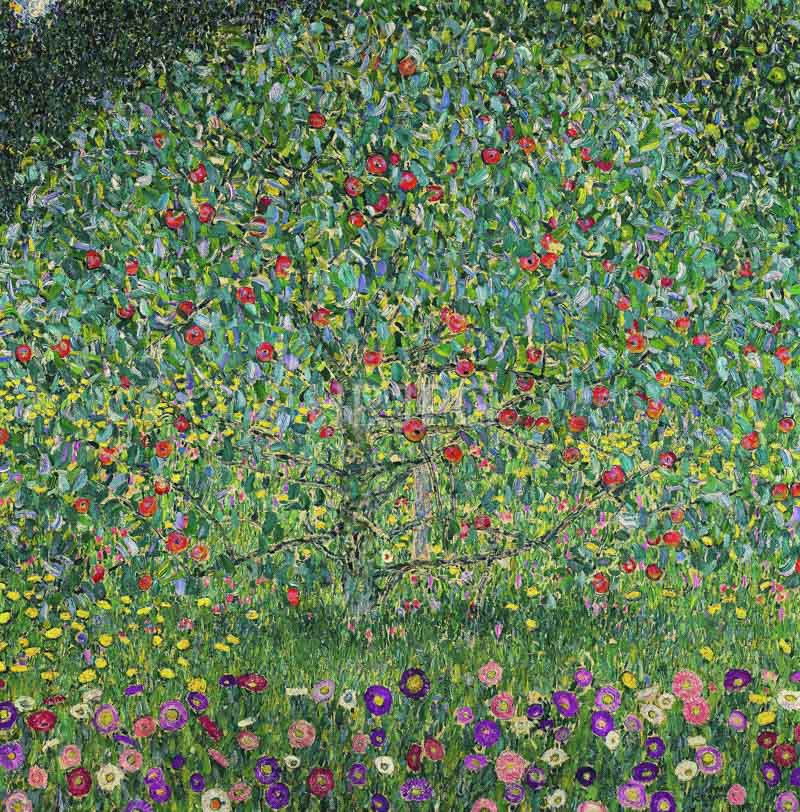
The lush and vibrant oil painting "Apple Tree I" was created by the Austrian master Gustav Klimt in 1912. This work is a premier example of his mature landscape style, produced during his annual summer retreats to Lake Attersee. During this period, Klimt moved away from the intense gold ornamentation of his middle years to explore a more "painterly" and atmospheric representation of the natural world. This painting captures the essence of summer abundance, transforming a simple orchard scene into a shimmering, decorative tapestry that reflects the artist's search for tranquility and modern order within nature.
Technically, the composition is a masterclass in "pointillist mosaic" and the use of a rich green palette. Klimt fills the square canvas with a dense arrangement of foliage and red fruit, effectively eliminating any traditional sense of horizon or sky. This creates a "flattened decorative surface" that forces the viewer's eye to wander through the rhythmic patterns of the leaves and the vibrant accents of the apples. The technique is a sophisticated evolution of Neo-Impressionism, where thousands of tiny brushstrokes are applied to create a shimmering effect that captures the play of light without relying on realistic three-dimensional modeling. The contrast between the deep greens of the leaves and the bright reds of the fruit creates a visual vibration that heightens the painting's sense of vitality. Klimt utilizes a compressed perspective, inspired by Japanese prints, which unifies the tree and the meadow into a single, intricate design. This approach highlights his ability to see the architectural structure within organic forms, turning a natural scene into a highly organized and modern visual language.
Historically, 1912 was a year of international recognition for Klimt, yet he continued to find his greatest inspiration in the quietude of the Austrian countryside. These landscapes were deeply personal, created for his own satisfaction rather than for public commissions. The work reflects the intellectual climate of "Modern Vienna," where the elite sought refuge in the beauty of the "Hortus Conclusus" (enclosed garden) as a sanctuary from the growing complexities of urban life. The painting captures the spirit of the "Reform movement" in gardening and design, where nature was treated as a primary source of aesthetic renewal and spiritual calm.
Art criticism has long celebrated "Apple Tree I" for its "extraordinary atmospheric quality" and its innovative synthesis of decorative grace and naturalistic observation. Critics such as Frank Whitford have noted that Klimt’s landscapes are "purely optical experiences," where the eye is invited to participate in the shimmer of color. The painting is praised for its "meditative stillness," a quality that distinguishes Klimt from the more chaotic energy of contemporary Expressionists. Modern scholars highlight the work as a masterpiece of early 20th-century Symbolism, noting its profound influence on the later developments of modern decorative art. Today, it remains a cornerstone of the Belvedere collection, standing as a testament to Klimt's unrivaled ability to transform a simple apple tree into a shimmering, eternal mosaic of summer color and life.