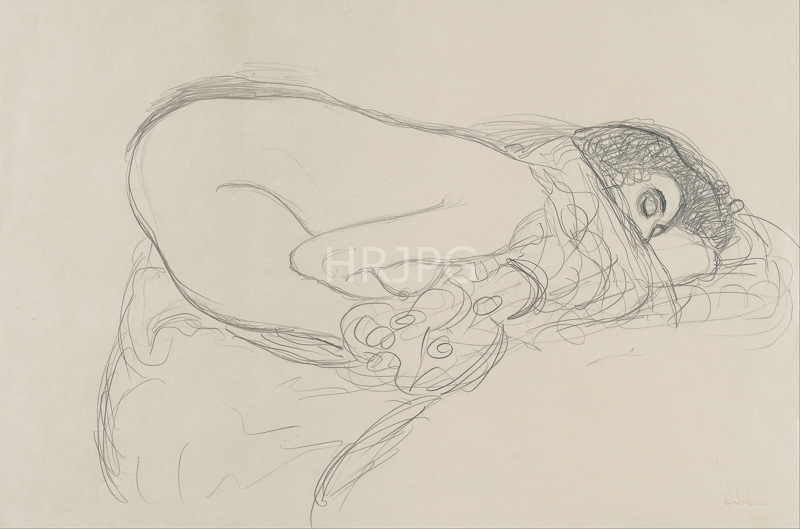
The evocative graphite sketch "Semi Nude leaning forward" was produced by Gustav Klimt in 1913. This work serves as a crucial preparatory study for his large-scale oil painting titled "Leda," depicting the mythological theme of Leda and the Swan. Created during his late mature period, the drawing offers a rare glimpse into Klimt's "meticulous process" of mapping the human form for complex allegorical compositions. By 1913, Klimt had abandoned the gilded "icons" of his middle years for a more "expressive and nervous" line work, influenced by his interaction with younger artists like Egon Schiele. This study is a testament to his ongoing fascination with "sensual movement" and the internal physical tension of the female body.
Technically, the composition is centered on the "contorted leaning pose" of the semi-nude woman. Klimt utilizes a series of "rhythmic and confident lines" to define the curves of the torso and the placement of the limbs. The pose is dynamic and unusual, capturing a moment of "unbalanced energy" that suggests both physical strain and emotional surrender. The "nervous vibration" of the line work is particularly notable; the contours are not static but seem to shift and pulse, suggesting the "internal life" and heat of the skin. Klimt omits unnecessary background detail or facial characterization, choosing instead to focus entirely on the "geometry of the body." The use of negative space around the figure creates a sense of "isolation and mystery," emphasizing the subject's vulnerability and its "weightless suspension" on the page. This approach to "anatomical simplification" reflects his late search for a "modern graphic language" that could convey the timeless power of myth through the raw, unvarnished grace of a contemporary model. The drawing showcases his ability to suggest three-dimensional volume through the sheer "economy of line," where the direction and weight of the pencil strokes convey the "structural truth" of the human form.
From a historical perspective, the "Leda" project reflects the enduring fascination of the Viennese Secession with "classical myth reimagined." Klimt sought to strip away the "heroic" filters of traditional academic history painting, presenting the mythological encounter as a "subjective psychological experience." This period in Vienna was marked by the "sexual revolution" in intellectual life, and Klimt’s drawings from this time act as a bridge between the decorative Art Nouveau movement and the raw, existential intensity of Expressionism. These studies were essential to his daily practice, serving as a vital record of his lifelong investigation into the "mysteries of desire."
Art criticism of the late 20th century has frequently highlighted the "graphic brilliance" of Klimt’s late figure studies. Critics like Alessandra Comini have argued that these works show Klimt at his most "authentic," revealing a deep empathy for his models. "Semi Nude leaning forward" is praised for its "expressive honesty" and its ability to convey a sense of "monumental beauty" through minimal means. Today, it remains a vital document for understanding the formal and psychological development of his late allegorical works, standing as a testament to his unrivaled ability to transform a preparatory sketch into a timeless investigation of the human spirit. It is regarded as a masterpiece of modern draftsmanship, proving that Klimt remained a pioneer in the artistic exploration of the body until the end of his life.