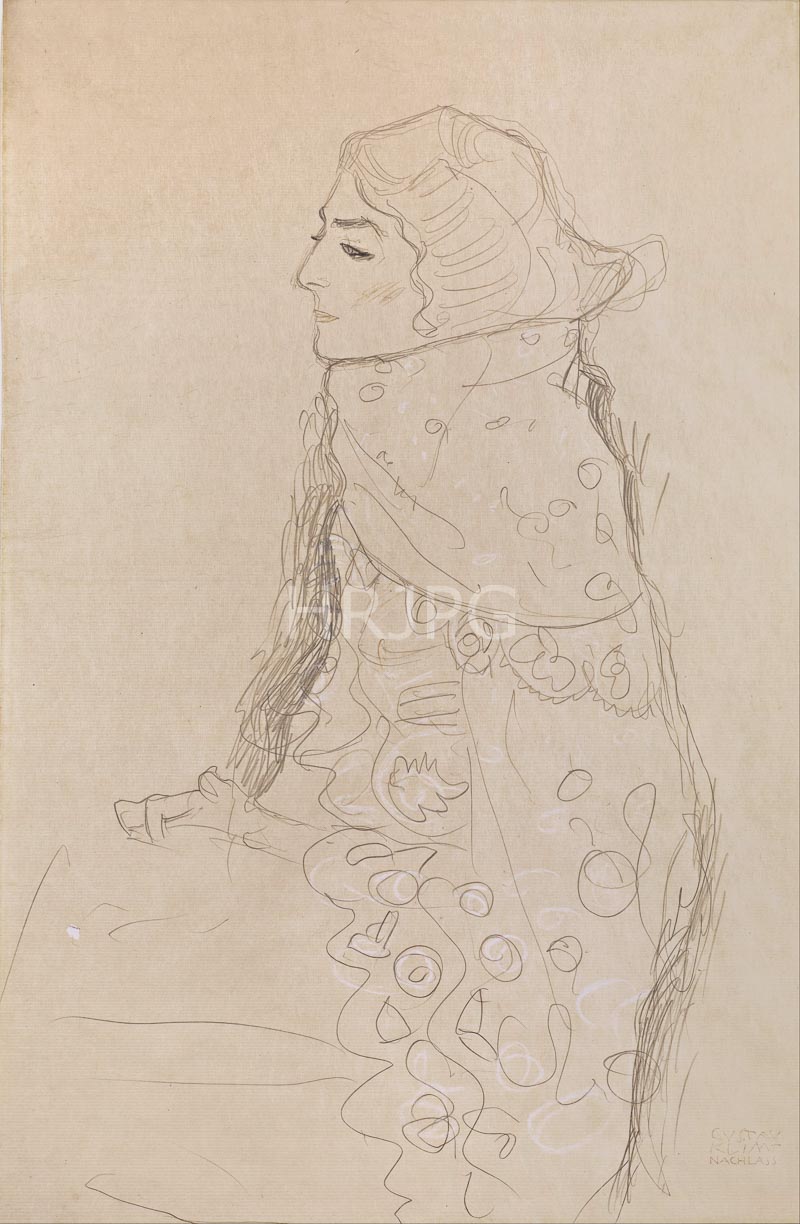
This detailed and sophisticated portrait study, "Seated Lady with Ornamented Cape in Profile from the Left," was executed by Gustav Klimt around 1910. It represents a significant moment in his late mature style, where he sought to balance the "psychological depth" of his subjects with the "decorative ornamentation" that had become his signature. During this period, Klimt was moving away from the heavy gold surfaces of his middle years toward a more "linear and atmospheric" approach. This drawing is part of a larger series of studies where he explored the relationship between the human face and the intricate textures of modern fashion, reflecting the high-society aesthetics and the "sophisticated atmosphere" of turn-of-the-century Vienna.
Technically, the work is characterized by the masterful contrast between the "fine modeling" of the face and the "rhythmic patterns" of the cape. Klimt depicts the seated lady in a sharp profile view, utilizing delicate, precise lines to define her refined features—the high forehead, the aristocratic nose, and the focused gaze. This profile view creates a sense of "dignified distance" and psychological introspection. The "ornamented cape" is rendered as a dense mosaic of geometric and floral patterns, echoing the revolutionary designs of the Wiener Werkstätte. Klimt uses the pencil to create a "visual vibration" within the textiles, where the lines of the pattern seem to flow and shift around the figure. This juxtaposition is a key technical detail; the "static" realism of the face is anchored by the "dynamic" decorative field of the garment. The composition is vertical and balanced, utilizing the white negative space of the paper to enhance the sense of the subject's "internal focus." This approach illustrates Klimt's mastery of "linear portraiture," where the clothing is not merely a costume but an extension of the subject’s personality and social status, creating a unified and modern aesthetic experience.
Historically, 1910 was a year of intense cultural fermentation in Vienna. The "Secessionist style" was being challenged by the raw emotionality of the early Expressionists, and Klimt responded by imbuing his decorative works with a new level of "human sensitivity." This study reflects the close relationship between the Viennese avant-garde and the Jewish upper-middle-class elite, such as the Bloch-Bauer and Gallia families, who were the primary patrons of Klimt's vision. The work captures the spirit of "Modern Vienna"—a city obsessed with the surface as a mirror of the soul and fashion as a medium for artistic liberation.
Art historians have consistently praised these late portrait studies for their "technical purity" and "psychological gravity." Critics like Christian Nebehay have argued that Klimt’s drawings from this period show his transition from a "virtuoso of realism" to a "master of modern characterization." The study is praised for its "sophisticated elegance," proving that Klimt could achieve a sense of monumental beauty through the most minimal graphic means. Today, it is regarded as a vital document for understanding the anatomical and decorative foundations of his late portraiture, standing as a testament to his unrivaled ability to capture the "aura" of a person through the elegance of a single line. It remains a moving and beautiful example of his search for the Gesamtkunstwerk within the human figure.