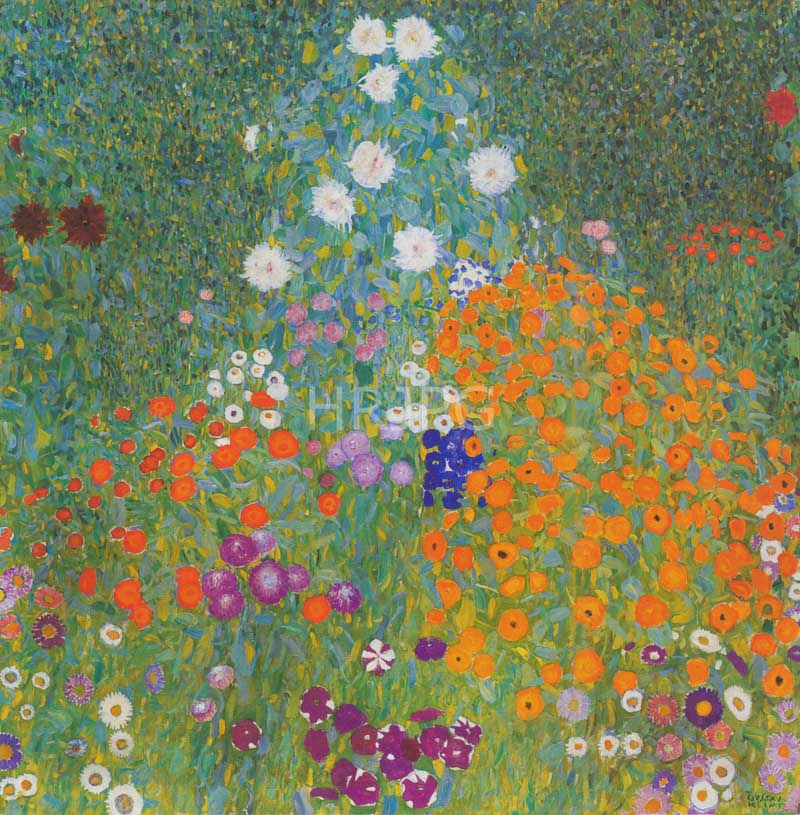
The vibrant and lush oil landscape "Flower Garden" was painted by the Austrian master Gustav Klimt approximately between 1905 and 1907. This work is a premier example of his "Golden Phase" landscapes, produced during his summer residencies at Lake Attersee. During this period, Klimt was increasingly fascinated by the idea of nature as an "immersive tapestry" of light and color, leading him to create works that blurred the line between naturalistic observation and decorative Symbolism. This painting serves as a visual manifestation of the Secessionist ideal of the Gesamtkunstwerk (total work of art), where every element of the natural world is woven into a single, shimmering, and modern aesthetic experience.
Technically, the composition is a masterclass in "mosaic-like pointillism" and the use of the square format. Klimt fills the entire canvas with a dense, "rustic garden" filled with poppies, daisies, and zinnias, effectively eliminating any sense of sky or traditional horizon. This approach creates a sense of "horror vacui" (fear of empty space), where every square inch of the surface is vibrating with color. Klimt utilizes thousands of small, rhythmic brushstrokes to create a "flattened decorative surface" that emphasizes pattern and texture over three-dimensional depth. The color palette is extraordinarily rich, featuring a symphony of reds, yellows, greens, and whites, applied with an intensity that reflects the influence of the French Neo-Impressionists. The "mosaic of color" transforms the natural scene into a shimmering tapestry, where the individual flowers lose their botanical identity to become part of a larger, rhythmic whole. The lack of a clear focal point forces the eye to wander across the surface, mirroring the "shimmering tones" and "sensory overload" of a summer day. This technique illustrates Klimt's search for a "decorative Symbolism," where nature is presented as a sacred and highly organized sanctuary of beauty.
Historically, 1905 to 1907 were years of intense creative output and international success for Klimt. His landscapes were highly coveted by the Viennese elite, who saw in them a refined, modern vision of beauty that offered refuge from the complexities of urban life. This work reflects the influence of "Japonisme" and the Byzantine mosaics of Ravenna on the Secessionist aesthetic, particularly their focus on the surface as a carrier of spiritual meaning. The painting captures the spirit of the "garden movement" in Vienna, where nature was treated as an outdoor "room" designed for aesthetic contemplation and spiritual renewal.
Art criticism has long lauded "Flower Garden" for its "extraordinary decorative intensity" and its "optical brilliance." Critics such as Frank Whitford have noted that Klimt’s landscapes are "purely optical experiences," and this painting is often cited as the ultimate example of his ability to see the sacred within the mundane. The work is praised for its "modernity," prefiguring the later developments of total abstraction by treating the landscape as a vehicle for pure color and rhythm. Today, it remains one of the most beloved works in the Belvedere collection, standing as a testament to Klimt's unrivaled ability to transform a simple rustic scene into a shimmering, eternal mosaic of summer life. It remains a vital link in the evolution of modern landscape art, proving that Klimt's brilliance was rooted in his ability to see the world as a unified and beautiful whole.