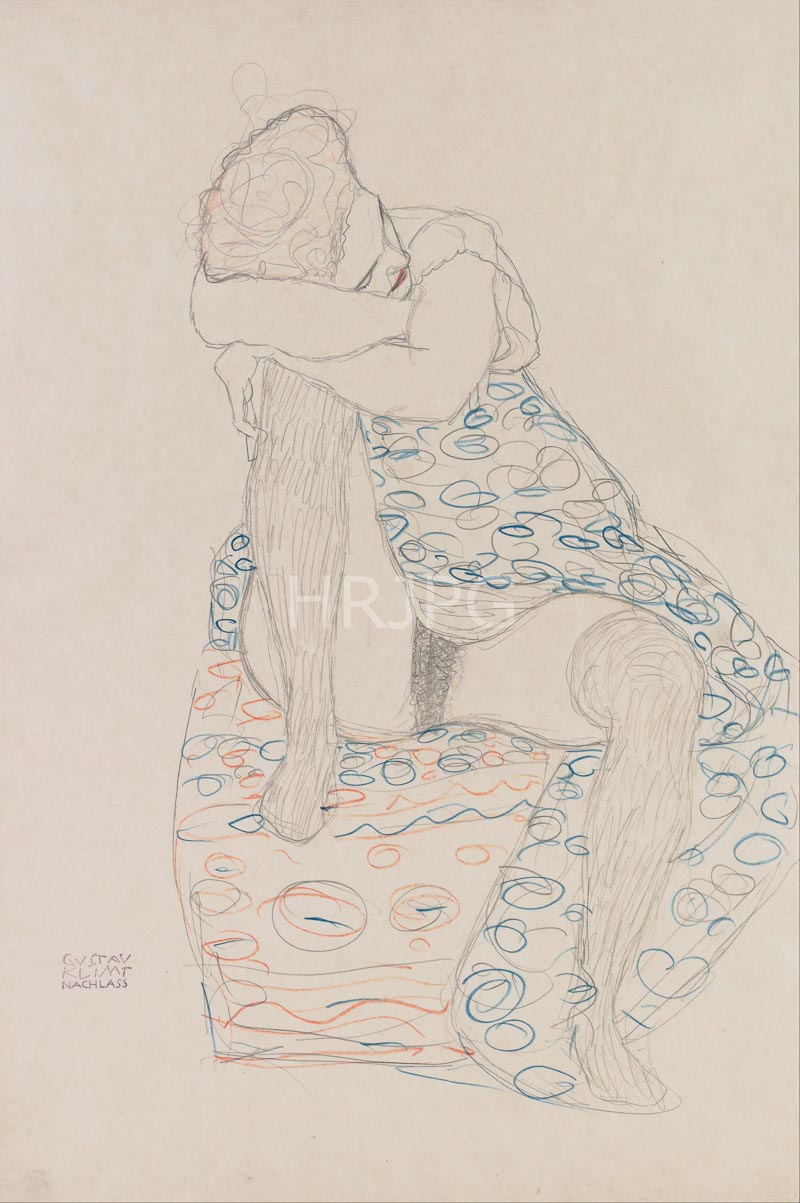
This masterful drawing in pencil with red and blue accents, titled "Seated Figure with Gathered up Skirt," was produced by Gustav Klimt in 1910. It belongs to his late mature period, a time when his graphic work moved away from the ornate "Golden Phase" toward a more raw, linear, and psychologically charged aesthetic. During this stage, Klimt utilized drawing as a daily laboratory to explore the intersection between the human form and the decorative potential of textiles. This work is a premier example of his search for "anatomical simplification," where the complexity of the human body is balanced against the intricate, rhythmic patterns of modern fashion, reflecting the sophisticated aesthetic of the Vienna Secession.
Technically, the work is defined by its "vibrating line" and the strategic use of color accents. Klimt captures a woman in a seated, introspective pose, with her head resting on her knees and her skirt gathered up to reveal her legs. The line work is remarkably fluid yet brittle, tracing the contours of the body with a sense of "nervous energy" that reflects the influence of younger Expressionists like Egon Schiele. The "red and blue accents" are applied sparingly to the patterns of the skirt and the features of the face, creating a subtle visual vibration that heightens the drawing’s sensuality. The composition is built on a series of overlapping curves and geometric shapes; the gathered skirt is treated as a dense mosaic of patterns that contrasts with the smooth, elongated lines of the exposed skin. This "linear elegance" allows the white space of the paper to act as a luminous environment, emphasizing the "vulnerability" and quietude of the subject. Klimt’s mastery lies in his ability to convey three-dimensional volume through the most minimal graphic means, using the varying pressure of the pencil to suggest weight and texture.
Historically, 1910 was a year of international consolidation for Klimt, marked by his success at the Venice Biennale. His drawings from this period were highly sought after by collectors who appreciated their "unvarnished honesty" and modern sensibility. This work reflects the changing feminine ideal in Vienna—a move away from the "femme fatale" toward a more realistic, sentient, and sometimes melancholic portrayal of women. The focus on the "gathered skirt" also highlights the close relationship between Klimt’s art and the revolutionary designs of the Wiener Werkstätte, where clothing was seen as a primary medium for modern artistic expression.
Art historians and critics have frequently praised these late studies for their "psychological resonance." Critics like Jane Kallir have argued that Klimt’s 1910 drawings show him at his most "authentic," revealing a deep empathy for his models. The work is praised for its "sophisticated simplicity," proving that Klimt could achieve a sense of monumental beauty without the need for gold leaf or complex allegory. Today, "Seated Figure with Gathered up Skirt" is regarded as a landmark in modern figurative art, demonstrating how the line could be used to capture the "inner feeling" of a pose. It remains a vital document for understanding the anatomical and decorative foundations of his late career, standing as a testament to his unrivaled mastery of the human form.