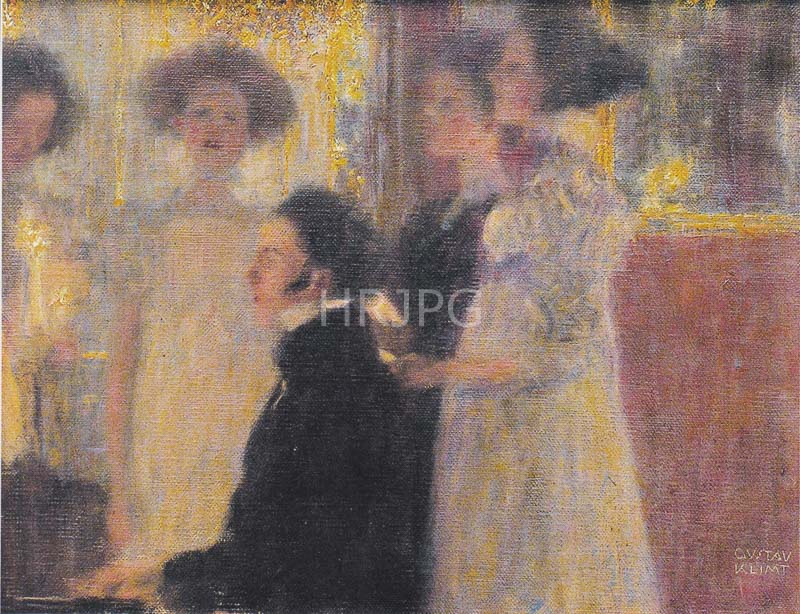
The evocative oil painting "Schubert at the Piano I" was created by Gustav Klimt around 1896. This work represents a critical turning point in Klimt's career, marking his transition from the rigid academicism of his early decorative commissions toward the enigmatic and atmospheric Symbolist style that would define the Vienna Secession. Commissioned by the wealthy industrialist Nikolaus Dumba for his music room, the painting was intended as a tribute to the great Austrian composer Franz Schubert. However, Klimt chose not to depict a historical scene with clinical accuracy, but rather to create a dreamlike, musical atmosphere that captured the "soul" of Schubert’s compositions, reflecting the cultural nostalgia of "Fin-de-Siècle" Vienna for its Biedermeier past.
Technically, the composition is a masterclass in the use of "soft atmospheric light" and a warm, intimate color palette. Klimt utilizes the glow of candlelight to illuminate the scene, creating soft transitions and blurred edges that evoke a sense of memory and ethereal beauty. Schubert is positioned at the piano, his profile partially shadowed, while a group of attentive women—clothed in contemporary yet stylized garments—surrounds him like musical notes on a staff. The brushwork is notably looser than his earlier historical murals, influenced by the tonalism of James Abbott McNeill Whistler. This approach prioritizes "mood" over detail, where the textures of the gowns and the wood of the piano seem to vibrate with the imagined sound of the music. The high contrast between the warm light on the figures and the deep, shadowy background creates a focal point that is both psychologically intimate and visually dramatic. By compressing the space, Klimt invites the viewer into this private salon, turning a historical portrait into a modern decorative experience.
Historically, this work was part of the "Dumba Salon," one of the most important private artistic commissions in late 19th-century Vienna. The project allowed Klimt to experiment with the idea of the Gesamtkunstwerk (total work of art), where the painting was integrated into the architectural and decorative scheme of the room. This period saw Klimt moving away from the "Künstlerhaus" tradition, seeking a more personal and expressive artistic voice that reflected the burgeoning psychological complexity of the era, paralleling the early discoveries of Sigmund Freud. The painting survived until 1945, when it was tragically destroyed by fire at Schloss Immendorf, making surviving photographs and studies vital records of this early masterpiece.
Art criticism has long identified "Schubert at the Piano I" as a seminal work of early Viennese Symbolism. Critics such as Frank Whitford have noted the "musicality" of the composition, describing it as a "visual symphony of light." The work is praised for its "nostalgic modernism," successfully blending the charm of Old Vienna with the radical techniques of the avant-garde. Modern scholars point to this painting as the moment when Klimt discovered the "power of the aura," a quality that would eventually culminate in his Golden Phase portraits. Today, it is regarded as a cornerstone for understanding Klimt's stylistic evolution, proving that his brilliance was rooted in his ability to capture the invisible—the atmosphere, the music, and the shifting spirit of an age.