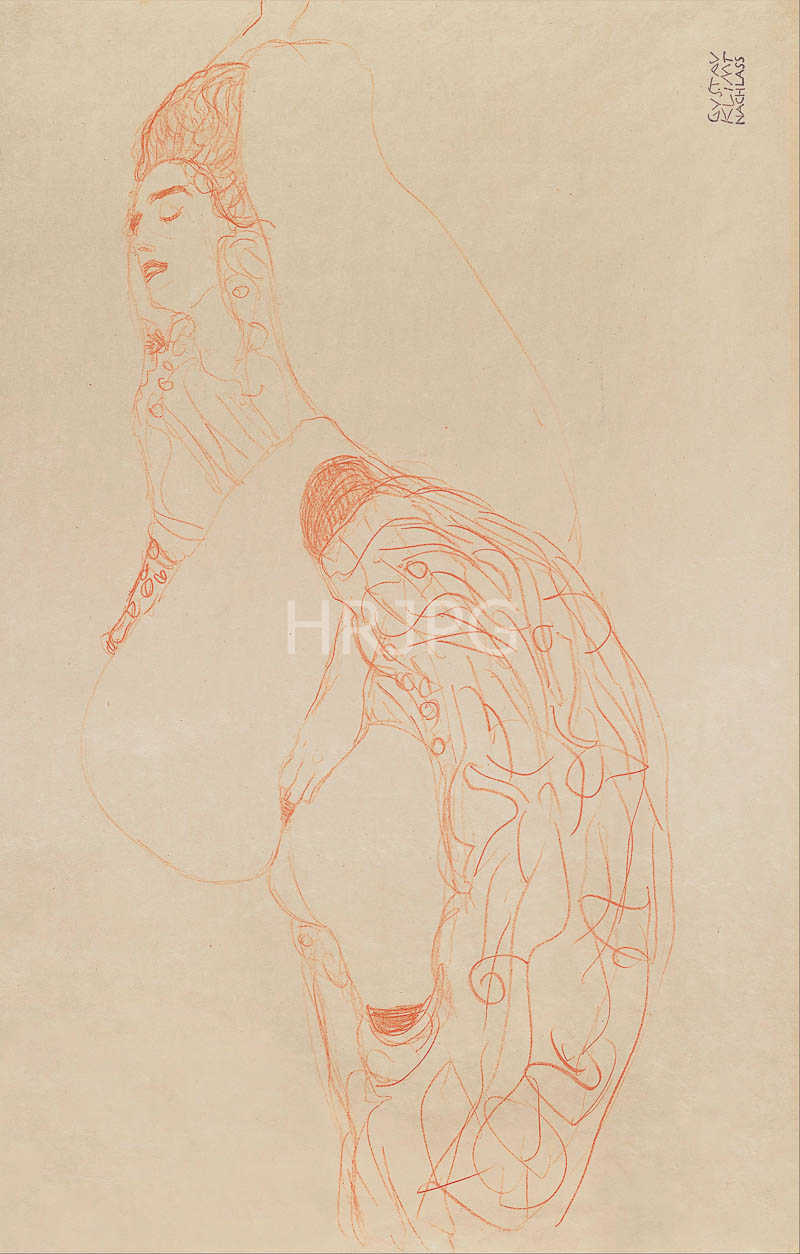
This evocative and powerful red chalk drawing, "Reclining Semi Nude Masturbating," was executed by Gustav Klimt approximately between 1912 and 1913. It belongs to his late mature period, a time when his graphic work reached its most "expressive and unapologetic" stage. During these final years, Klimt retreated from the monumental, gold-laden paintings of his middle career to focus on the raw, psychological intensity of the human form within his private studio practice. This work is a premier example of his "unvarnished exploration" of human sexuality, rendered with a level of anatomical grace and emotional honesty that was radical for its time, reflecting the profound influence of the "sexual revolution" in Viennese intellectual life.
Technically, the work is defined by its "fluid and confident lines" and the warm, atmospheric quality of the red chalk (sanguine). Klimt utilizes a range of rhythmic curves to define the contorted, ecstatic posture of the semi-nude woman. The lines are remarkably energetic, varying in weight to suggest the "physical tension" and the internal emotional intensity of the subject. Unlike his earlier, more static drawings, this late work captures a sense of "dynamic motion" and "psychological surrender." There is a masterful balance between the "realism of the gesture" and the "simplification of the form." The artist omits any environmental context or detailed facial features, choosing instead to let the "geometry of the body" and the "expressive power of the line" convey the state of private physical intimacy. The choice of red chalk adds a sense of "warmth and fleshiness" to the drawing, enhancing the tactile and erotic quality of the scene. The use of negative space around the figure creates a sense of "isolation and privacy," making the viewer feel like a witness to a moment of profound internal truth.
Historically, this drawing reflects the intellectual climate of "Fin-de-Siècle" Vienna, a city deeply preoccupied with the mysteries of the psyche and the complexities of desire. Influenced by the works of Sigmund Freud and Arthur Schnitzler, Klimt sought to represent the "hidden life" of his subjects. This work captures the "liberation of the body" that was central to the Viennese avant-garde's mission, challenging the moral taboos of the era with a sincere investigation of human sexuality. This period in Klimt’s life was marked by a shift toward "International Modernism," where he sought to find universal truths through the most intimate and personal human experiences.
Art historians and critics have long identified Klimt’s late erotic drawings as the "raw nerve" of his creative legacy. Critics such as Alessandra Comini have argued that these works show Klimt at his most "authentic," revealing a deep empathy for his models. The drawing is praised for its "unapologetic honesty" and its ability to convey a sense of "monumental presence" through the most minimal means. It is regarded today as a cornerstone of modern figurative art, demonstrating the shift from the decorative traditions of the 19th century to the raw, psychological intensity of the 20th century. "Reclining Semi Nude Masturbating" remains a moving and powerful testament to Klimt's unrivaled ability to capture the complex, intimate, and sacred landscape of the human spirit.