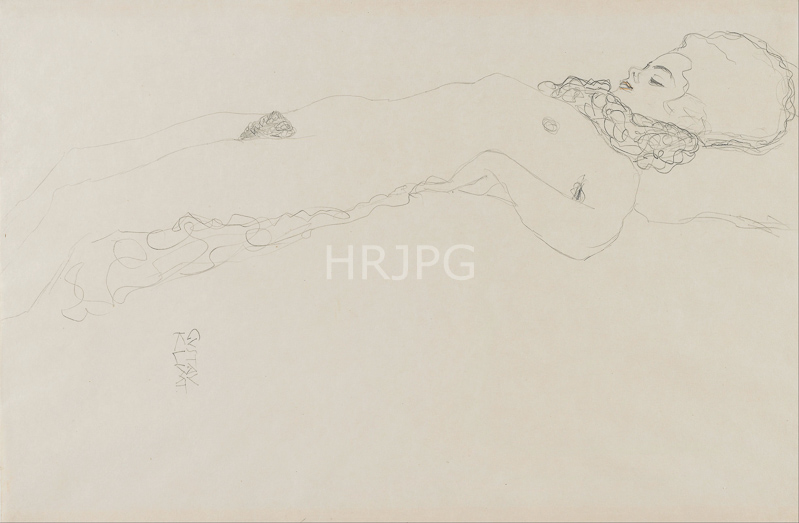
This intriguing and refined pencil drawing, "Naked Girl with Ruff lying," was produced by Gustav Klimt between 1905 and 1906. It belongs to a specific subset of his private figure studies where he experimented with the contrast between "modern nudity" and "historical costume." This period in Klimt's life was defined by his obsession with the feminine form and his role as the leader of the Viennese avant-garde, where he sought to liberate the body from Victorian social restrictions. The inclusion of the "ruff collar"—a stiff, pleated historical garment—serves as a daring and ironic counterpoint to the raw, unvarnished grace of the reclining nude, reflecting the artist's fascination with the interplay between tradition and modern sensuality.
Technically, the drawing is a masterclass in "elongated form" and sensitive line work. Klimt utilizes a horizontal composition to emphasize the "graceful posture" and the relaxed weight of the body. The lines are remarkably fluid yet precise, tracing the contours of the reclining girl with a sense of "anatomical simplified grace." The "ruff collar" is rendered with a dense, rhythmic pattern of lines that contrasts sharply with the smooth, soft contours of the skin. This juxtaposition is a key technical detail; the rigid geometry of the historic garment highlights the organic, flowing lines of the nude. There is almost no shading; instead, Klimt relies on the "vibration of the contour" and the varying pressure of the pencil to suggest volume and presence. The subject's expression is one of "quiet introspection," caught in a private, dreamlike space that is enhanced by the white negative space of the paper. This approach illustrates Klimt's search for an "essentialist" draftsmanship, where the gesture itself is the primary carrier of emotion and mystery.
From a historical perspective, this work reflects the "Fin-de-Siècle" preoccupation with the "subversion of tradition." By placing a modern, vulnerable nude in a historical accessory, Klimt challenges the viewer’s expectations and explores the "fetishistic" qualities of clothing. This was a time when the works of Sigmund Freud were encouraging artists to look beneath the surface of social roles to find the deeper, instinctual truths of humanity. The drawing captures the "intimate nature" of Klimt’s studio practice, where he moved away from the public "Golden Phase" allegories to focus on the private world of his models, reflecting a more "personal and empathetic" artistic vision.
Art criticism of the late 20th century has frequently highlighted the "sophisticated irony" of Klimt’s costume studies. Critics like Jane Kallir have argued that these works show Klimt at his most "modern," as they play with the concepts of identity and performance. The drawing is praised for its "melodic quality" and its ability to convey a sense of "timeless elegance" through the most minimal graphic means. Today, "Naked Girl with Ruff lying" is regarded as a landmark in modern figurative art, demonstrating how a simple line could capture the complex tensions between the past and the present. It remains a moving and beautiful example of Klimt's ability to see the extraordinary grace within the simplest, most intimate human form.