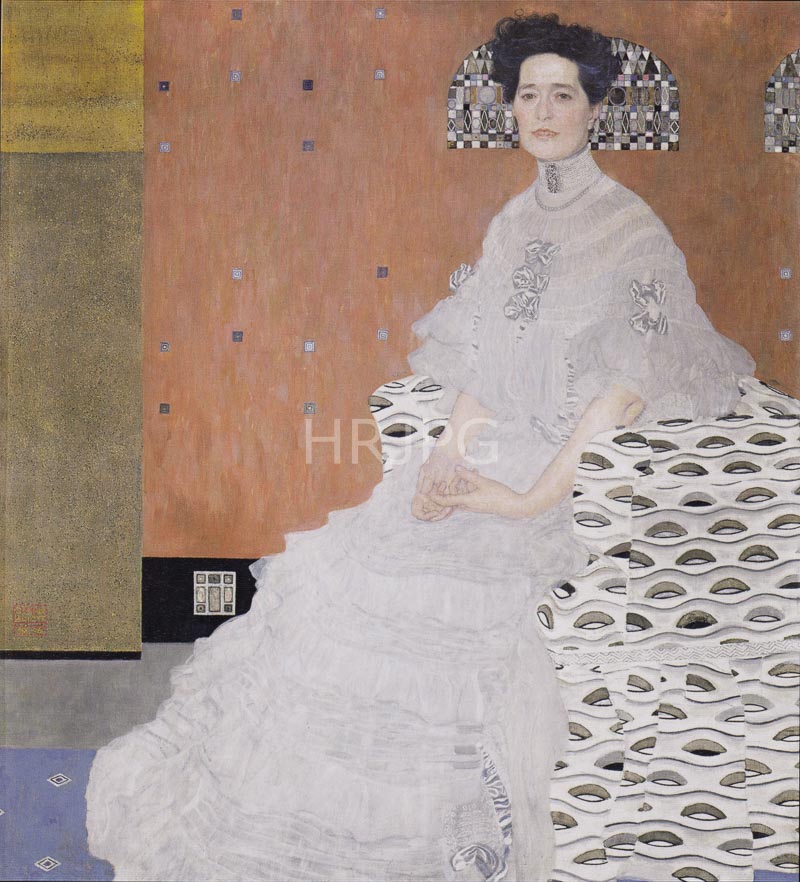
The monumental oil portrait of Fritza Riedler was created by Gustav Klimt in 1906, representing the absolute peak of his "Golden Phase." This work is widely considered one of the most successful and innovative examples of modern Viennese portraiture. Fritza Riedler was the wife of Alois Riedler, a prominent professor of engineering and a member of the city’s wealthy industrialist elite. This commission illustrates the close ties between Klimt and the forward-thinking families who sought to define their modern social status through the radical aesthetic of the Secession. The portrait is a masterclass in the synthesis of "realistic modeling" and "highly geometric abstraction," reflecting the era's pursuit of the Gesamtkunstwerk or total work of art.
Technically, the composition is a profound study in "stylized contrast." Fritza’s face and hands are rendered with a three-dimensional, academic realism that captures her refined features and dignified expression with great sensitivity. However, her body and the surrounding environment are transformed into a dense, two-dimensional mosaic of patterns. She is seated in an armchair that has been abstracted into a series of geometric shapes, adorned with "eye-like" motifs and gold accents. The background is a shimmering, flattened decorative surface of silver and gold dabs, which pushes the subject to the very front of the picture plane. Klimt utilizes a "compressed perspective" and a high horizon line, inspired by both Byzantine mosaics and Japanese woodblock prints. The use of the "stained glass" effect in the armchair and the intricate ornamentation of the gown create a visual vibration that heightens the painting's sense of luxury and architectural order. This approach allows Klimt to present the subject not just as a person, but as a "precious icon" within a modern, decorative shrine.
Historically, 1906 was a year of immense creative output and international recognition for Klimt. His portraits of this period, including those of Adele Bloch-Bauer, were redefining the genre by merging the "inner life" of the subject with a monumental, public persona. The influence of Diego Velázquez is evident in the "stately pose" and the use of the chair as an architectural element, but Klimt pushes the decorative language of the Jugendstil to its absolute limit. This work reflects the "Fin-de-Siècle" obsession with the surface as a carrier of symbolic meaning, where the density of the pattern represents the complexity of the subject’s social and psychological world.
Art criticism has long lauded the "Portrait of Fritza Riedler" for its extraordinary technical refinement and its innovative design. Critics such as Frank Whitford have noted the "tapestry-like" quality of the work, describing it as a "symphony of geometry." The painting is praised for its "psychological gravity," as Fritza’s calm, almost detached expression provides a sense of quietude amidst the riotous ornamentation. Modern scholars highlight the work as a masterpiece of early 20th-century Symbolism, noting its profound influence on the development of modern decorative art and fashion. Today, it remains a centerpiece of the Belvedere collection in Vienna, standing as a testament to Klimt's unrivaled ability to transform a traditional societal commission into a shimmering, eternal mosaic of modern life.