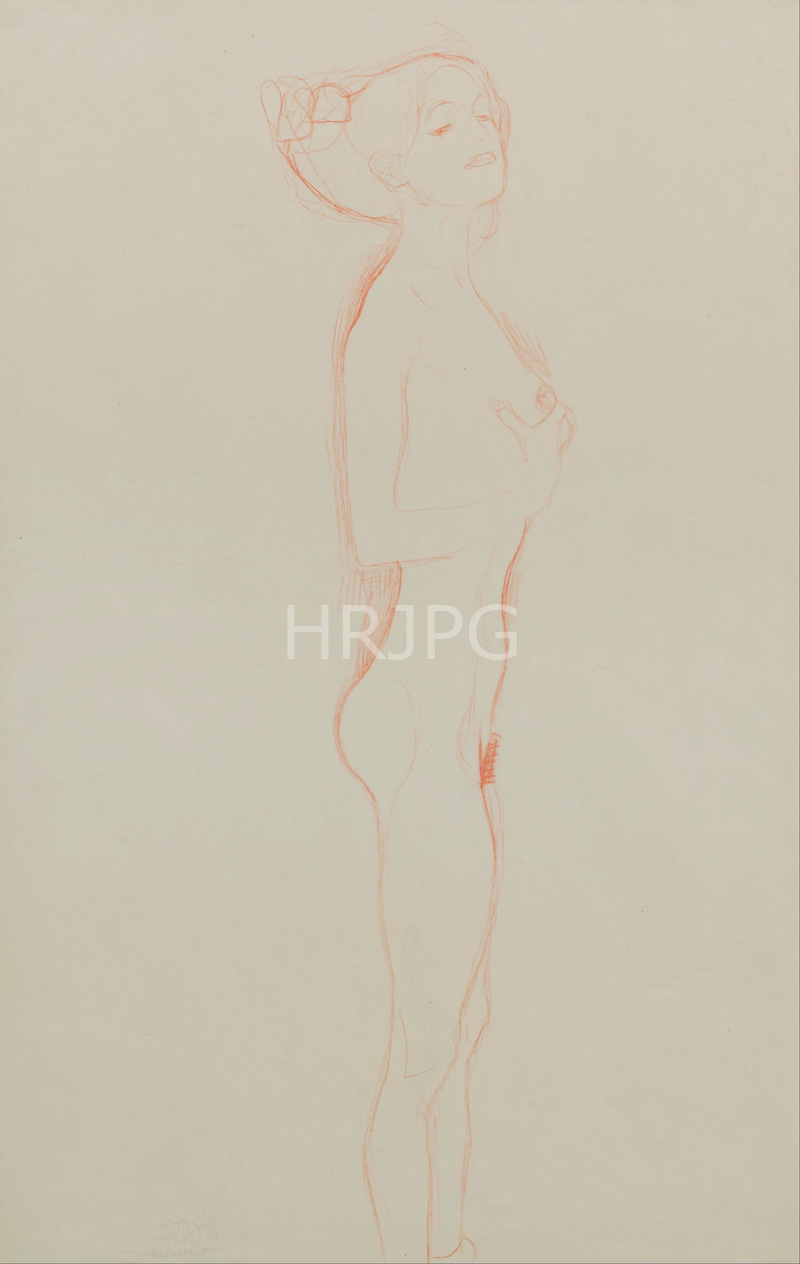
This provocative and intimate pencil drawing, "Naked Girl Standing with Right Hand to Breast," was produced by Gustav Klimt in 1906. This work belongs to his extensive and legendary collection of erotic nudes, which he produced daily as part of his private artistic practice. By 1906, Klimt had reached the peak of his "Golden Phase" in painting, but in his graphic work, he sought a far more "unvarnished and raw" exploration of the human form. His studio was a space of constant movement and relative freedom for his models, and this drawing captures a moment of delicate gesture and physical vulnerability that was largely hidden from the public eye during his lifetime. It represents a significant investigation into the "truth" of the female body, stripped of the decorative armor of gold leaf and complex allegory.
Technically, the work is characterized by its "quick, nervous brushstrokes" (or strokes of the lead) and intricate, overlapping lines. Klimt utilizes a gestural approach to define the standing figure, focusing on the specific posture where the right hand is brought to the breast. This gesture is both "provocative and protective," creating a sense of psychological tension that is central to the work's power. The artist uses a range of rhythmic, brittle lines to map the volume of the torso and the softness of the skin, emphasizing the organic and sometimes imperfect reality of the human body. There is almost no traditional cross-hatching; instead, the "vibration of the line" itself suggests shadow and presence. The composition is vertical and focused, utilizing the white paper as a luminous environment that enhances the sense of isolation and intimacy. This approach reflects the influence of the "Japanese line" and the emerging Expressionist movement, where the artist’s subjective reaction to the model is prioritized over objective anatomical accuracy.
Historically, these erotic drawings reflect the changing moral and intellectual climate of pre-war Vienna. Influenced by the radical ideas of Otto Weininger and Sigmund Freud, Klimt sought to represent the "unconscious life" of his subjects. While his public portraits were often highly idealized and ornate, his drawings were a sanctuary of "erotic honesty." This period saw Klimt moving toward a more "human" and less "iconic" representation of women, reflecting his personal relationships and his ongoing rebellion against the moral hypocrisy of the Viennese middle class. These works were essential to his development, serving as a laboratory for the formal experiments that would appear in his later, more expressive paintings.
Art historians and critics have long identified Klimt’s erotic studies as some of the most innovative and important graphic works of the early 20th century. Critics like Alessandra Comini have argued that these works show Klimt at his most "authentic," revealing a deep empathy for his models. The drawing is praised for its "sensitive line work" and its ability to convey a sense of monumental beauty within a private, almost voyeuristic moment. It is regarded today as a cornerstone of modern figurative art, demonstrating the shift from the idealized academic nude to the psychological and expressive honesty of the 20th century. The work remains a powerful testament to Klimt’s enduring fascination with the elegance, mystery, and raw grace of the female form.