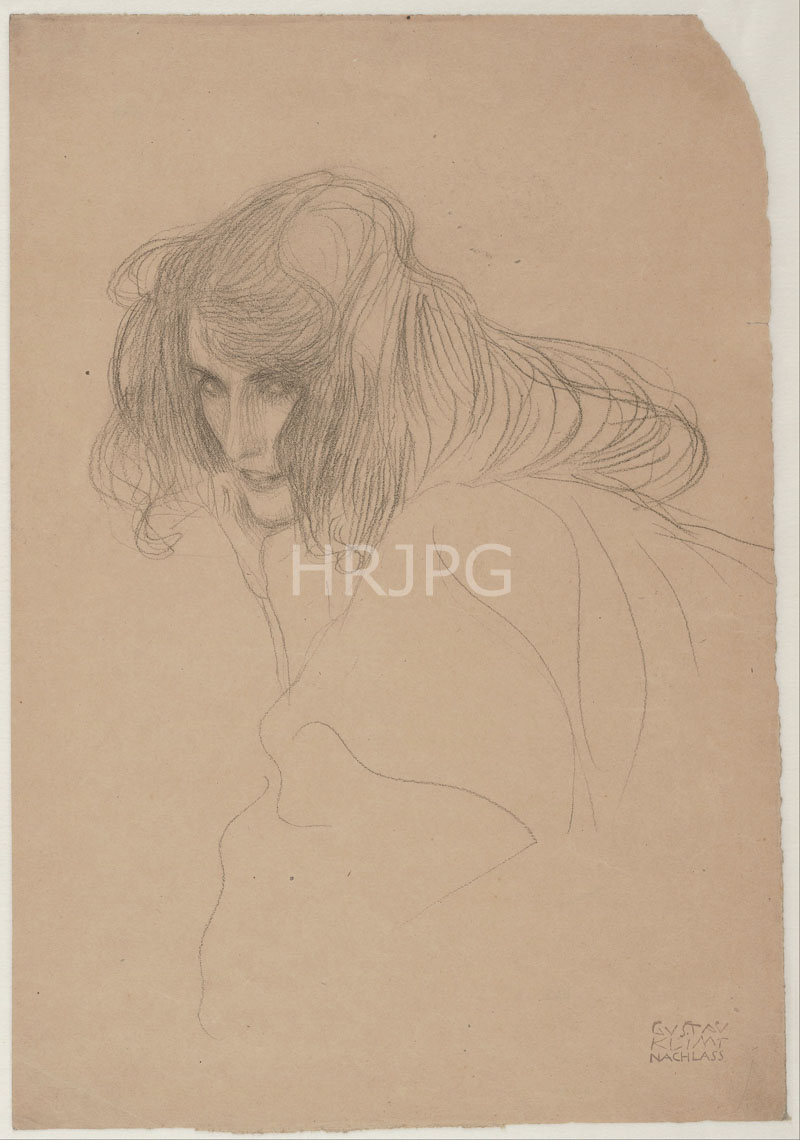
The refined pencil drawing "Head of a Woman in Three Quarter Profile" was executed by Gustav Klimt around 1901 to 1902. This work is not merely a portrait but a vital preparatory study for his monumental "Beethoven Frieze," specifically intended for the figures representing "Spiritual Longing." This was a period of immense creative tension for Klimt, as he prepared for the 14th Vienna Secession exhibition, which was dedicated to the genius of Ludwig van Beethoven. The frieze itself was intended as a "Gesamtkunstwerk" (total work of art), and this study offers a rare glimpse into the meticulous graphic foundations of Klimt's most ambitious allegorical project. The woman’s expression, caught in a state of visionary introspection, serves as a psychological anchor for the complex narrative of human suffering and redemption that the frieze portrays.
Technically, the drawing is a masterclass in the use of "delicate, continuous lines" to define volume and mood. Klimt utilizes a three-quarter profile to create a sense of depth and contemplative distance. The hair is rendered as a rhythmic, flowing mass that anticipates the cascading, decorative patterns of his "Golden Phase." There is a remarkable sense of "linear economy" here; the artist relies on the varying weight and pressure of the graphite to suggest the soft contours of the face and the intense, melancholic gaze of the eyes. Shading is minimal, used only to define the subtle hollows of the cheeks and the bridge of the nose, which emphasizes the "ethereal" and visionary quality of the subject. This approach marks a significant shift from his earlier academic realism toward a more "subjective and symbolic" draftsmanship, where the line itself becomes a carrier of spiritual longing. The use of negative space around the head creates a vacuum of quietude, forcing the viewer to engage directly with the internal life of the subject.
Historically, the "Beethoven Frieze" was part of a larger cultural movement to celebrate the "heroic" spirit of art in the face of modern materialism. Klimt’s contribution was radical, as he depicted humanity as vulnerable and driven by unconscious desires, an idea deeply influenced by the burgeoning field of psychoanalysis in Vienna. This specific study shows how Klimt sought to find a "modern face" for ancient allegorical themes. The figure of longing was a central motif in Secessionist art, representing the artist's own search for a higher aesthetic truth amidst the social and political upheavals of "Fin-de-Siècle" Austria.
Art criticism has frequently highlighted the "psychological depth" of Klimt’s frieze studies. Critics like Frank Whitford have noted that Klimt’s lines possess a "nervous energy" that captures the modern Viennese anxiety. The drawing is praised for its "monumental fragility," proving that Klimt could achieve a sense of overwhelming spiritual weight through the simplest graphic means. Contemporary scholars often point to this work as a masterpiece of "Secessionist graphicism," noting its profound influence on the development of modern figurative art. Today, it remains a vital document for understanding the anatomical and psychological foundations of the "Beethoven Frieze," standing as a testament to Klimt's unrivaled ability to capture the complex landscape of the human soul through the elegance of a single line.