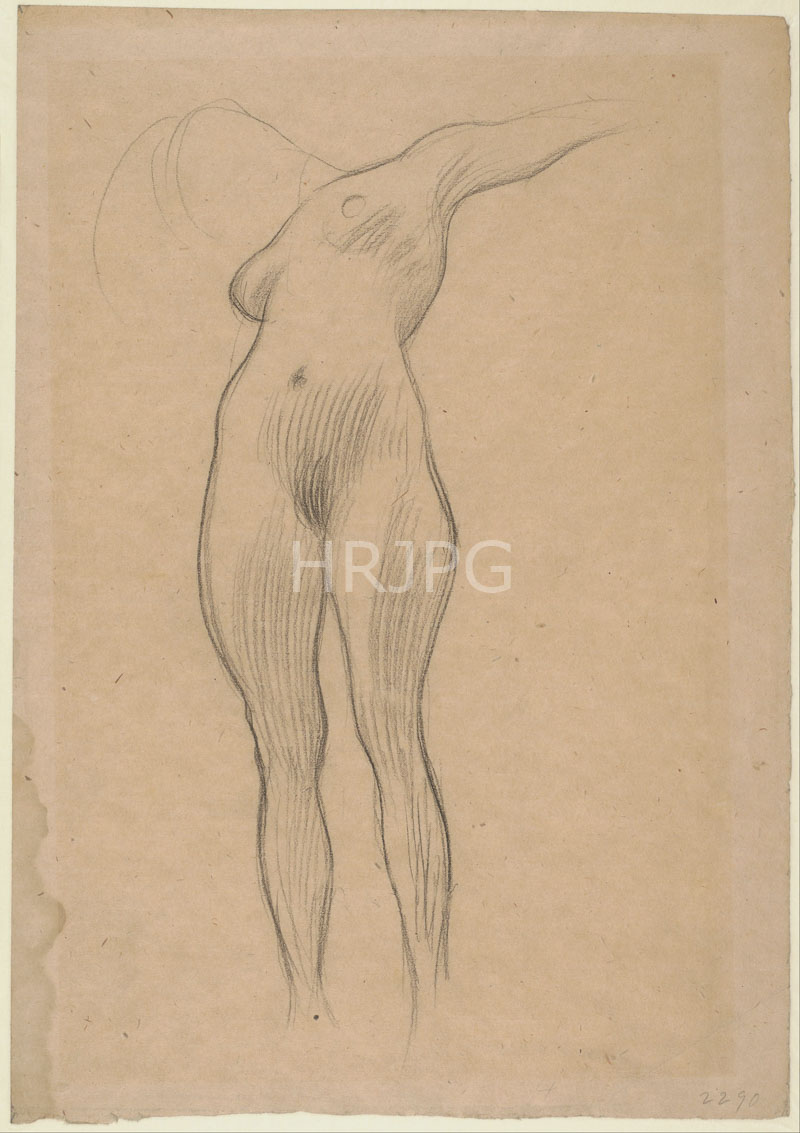
This hauntingly beautiful graphite sketch, "Floating Woman with Outstretched Arm," was executed by Gustav Klimt around 1900 to 1901. It serves as a crucial preparatory study for his monumental and highly controversial university painting titled "Medicine," one of the three "Faculty Paintings" commissioned by the University of Vienna. This period in Klimt’s life was marked by intense public scrutiny and scandal, as he challenged the traditional, academic views of the institution with his radical Symbolist visions. This drawing is a testament to his search for a "modern allegory" that could convey the weightless, ethereal nature of the human spirit caught in the eternal cycle of life and death.
Technically, the work is defined by its "weightless suspension" and the masterful use of the diagonal composition. Klimt depicts a female figure floating horizontally across the page, her arm outstretched in a gesture that suggests both reaching and surrender. The line work is remarkably sensitive and fluid, tracing the contours of the body with a sense of "ethereal lightness." There is very little internal shading; instead, the artist relies on the "contour" and the varying pressure of the pencil to suggest volume and movement within a void. The figure appears as if caught in a state of "liminality"—neither fully present nor entirely absent—which reflects the thematic core of the "Medicine" mural. The outstretched arm creates a dynamic leading line that guides the eye through the composition, emphasizing the sense of an individual soul adrift in a vast, collective destiny. This "anatomical simplified form" marks a significant departure from the static, grounded nudes of his earlier career, illustrating his move toward a more "subjective and psychological" representation of the human condition.
Historically, the "Medicine" mural project was a pivotal moment for the Vienna Secession. Klimt’s depiction of humanity as a helpless "chain of figures" at the mercy of fate was rejected by the academic establishment, who expected a triumphalist celebration of scientific progress. This drawing captures the "raw nerve" of Klimt’s artistic intent, focusing on the individual's vulnerability within the cosmic cycle. The work reflects the intellectual climate of "Fin-de-Siècle" Vienna, which was deeply influenced by the burgeoning field of psychoanalysis and the philosophical writings of Schopenhauer, who saw existence as a blind, irrational "will."
Art historians have long identified these "Medicine" studies as some of the most innovative graphic works of the early 20th century. Critics like Alessandra Comini have noted that Klimt’s drawings from this period are "more revealing than his finished paintings," as they show the unvarnished exploration of his allegorical themes. "Floating Woman with Outstretched Arm" is praised for its "monumental quietude" and its ability to convey profound existential anxiety through a simple, graceful gesture. Today, it remains a vital document for understanding the development of modern Symbolism and the shift from the 19th-century focus on "heroic realism" to the 20th-century obsession with the internal life of the spirit. It stands as a moving tribute to the fragility and resilience of human hope.