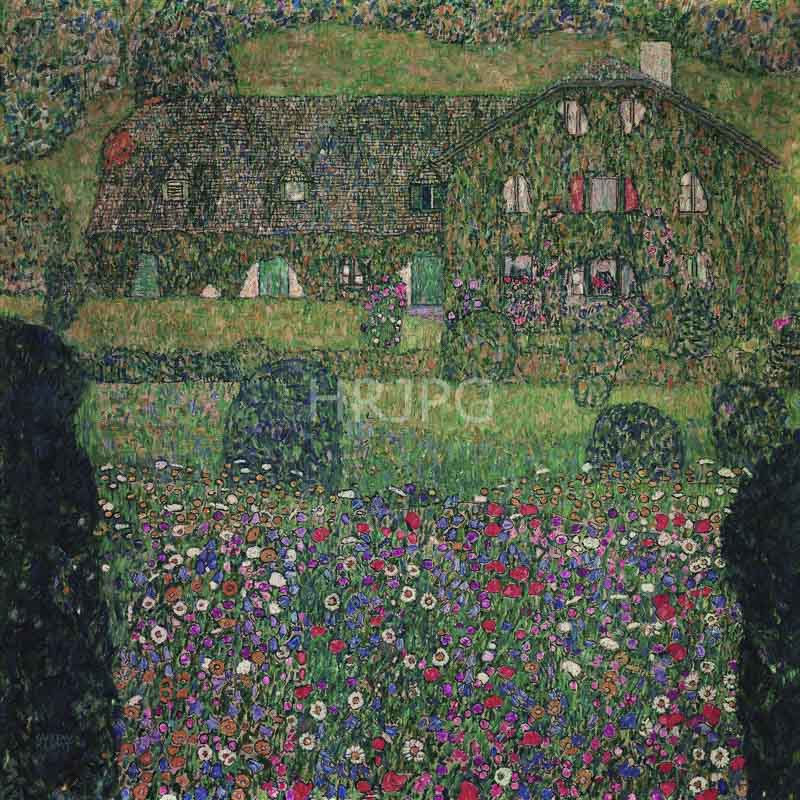
The vibrant and lush oil landscape "Country House by the Attersee" was painted by Gustav Klimt around 1914. This work depicts a secluded country house in Weissenbach, a location near Lake Attersee where Klimt spent his final summer retreats. Produced during his late mature period, the painting represents his transition into the "International Style," where his earlier obsession with gold ornamentation was replaced by a more painterly and expressive focus on color and texture. Amidst the gathering shadows of World War I, Klimt sought refuge in the "tranquil rhythms" of the Austrian countryside, and this work serves as a profound celebration of that rural beauty and the enduring abundance of nature.
Technically, the painting is a masterclass in "mosaic-like" pointillism and the use of compressed perspective. Klimt fills the square canvas with a dense field of multi-colored flowers that seem to surge toward the viewer, effectively eliminating any sense of middle ground. The "country house" of the title is nestled within this explosion of greenery, its architectural lines integrated into the overall decorative pattern of the landscape. Klimt utilizes thousands of small, rhythmic brushstrokes to create a "flattened decorative surface" that vibrates with light. The color palette is extraordinarily rich, featuring a symphony of pinks, purples, oranges, and deep greens, applied with an intensity that reflects the influence of the French Fauves and Van Gogh. There is no traditional horizon or sky visible; instead, the entire scene is transformed into a "shimmering tapestry" where the distinction between nature and man-made structure begins to dissolve. This "all-over" composition forces the eye to wander through the textured richness of the paint, appreciating the rhythmic beauty of the field as a single, unified aesthetic experience.
Historically, this painting reflects Klimt’s deep personal connection to the Attersee region and his close relationship with the Primavesi family, who owned the house in Weissenbach. His summer landscapes were his most private works, created for his own artistic fulfillment rather than for public commissions. This period in Vienna was marked by the collapse of the old empire, and Klimt’s retreat into the garden can be seen as a form of "internal exile" from the political and social turmoil of the city. The work exemplifies the Secessionist ideal of the Gesamtkunstwerk, where even a simple farmhouse is treated as a component of a total, modern work of art.
Art historians have consistently praised "Country House by the Attersee" for its "shimmering atmospheric quality" and its innovative synthesis of Impressionist light and Art Nouveau design. Critics such as Frank Whitford have noted that Klimt’s late landscapes are "purely optical experiences," where the landscape becomes a vehicle for pure color and rhythm. The painting is praised for its "modernity," prefiguring the later move toward total abstraction. Today, it remains one of the highlights of the Belvedere collection, standing as a testament to Klimt's ability to see the extraordinary and sacred beauty within the density of a summer garden. It is a powerful reminder of the resilience of the human spirit through the celebration of the natural world.