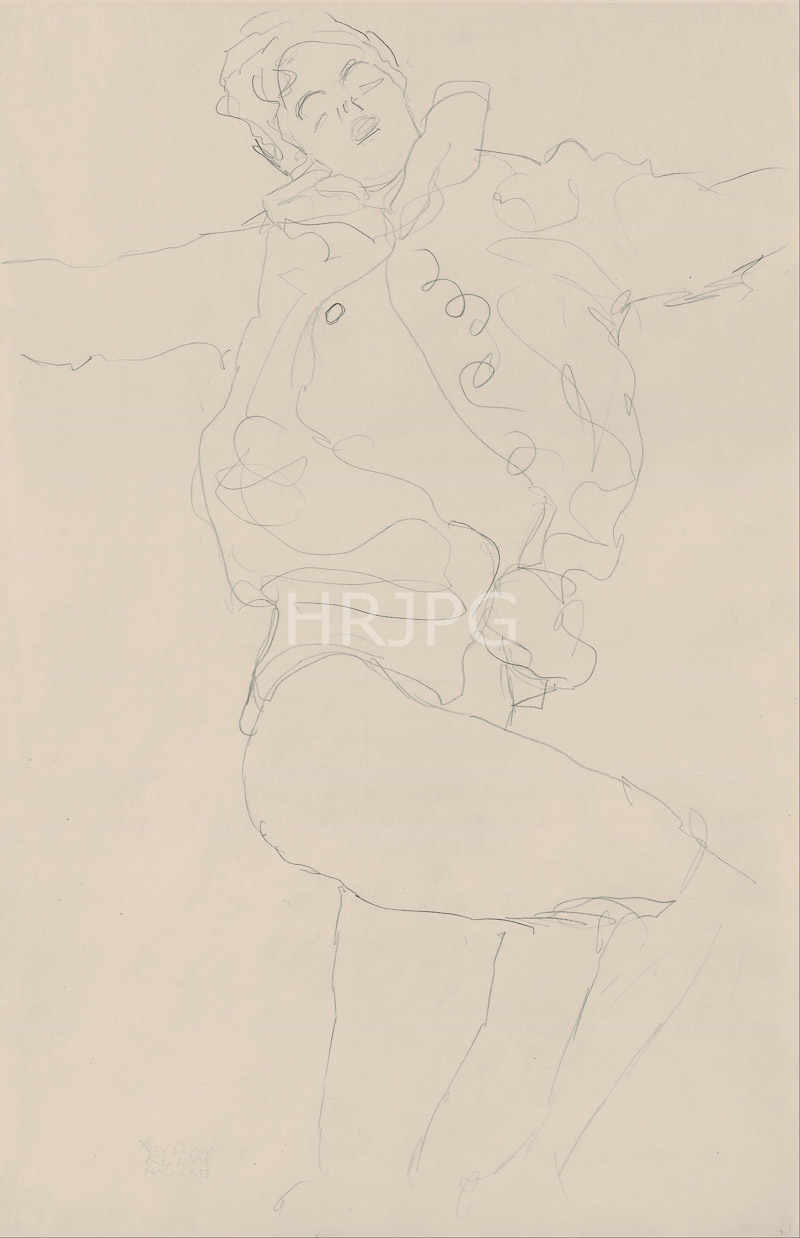
The spontaneous and highly dynamic pencil drawing "Dancing Woman with Cape" was executed by Gustav Klimt around 1900. This work was produced during a critical turning point in his career, as he moved away from the formal constraints of academic realism toward the fluid, expressive draftsmanship that would define the Vienna Secession. At the turn of the century, Klimt was increasingly fascinated by the representation of "becoming"—the capture of the human form in a state of rapid, unposed motion. This drawing serves as a vital record of his mastery in representing physical joy and the rhythmic elegance of the body through purely graphic means, reflecting the avant-garde spirit of modern Vienna.
Technically, the composition is a masterclass in the use of "minimalist, energetic lines" to convey a sense of weightless suspension. Klimt captures the dancer in mid-motion, her body angled away from the viewer while her voluminous cape swirls around her in a complex, rhythmic arc. The lines are remarkably fluid yet controlled, varying in thickness to suggest the "centrifugal force" of the dance. There is no shading or anatomical cross-hatching; instead, the artist relies entirely on the "contour" to define the volume of the figure and the texture of the fabric. This "linear economy" allows the white space of the paper to act as a luminous environment, emphasizing the "fluidity" and spontaneity of the gesture. The cape itself becomes an extension of the woman’s body, transformed into a swirling, decorative pattern that anticipates the flowing garments of his later "Golden Phase" allegories. This technique illustrates Klimt's search for an "essentialist" draftsmanship, where the gesture itself is the primary carrier of meaning and emotion.
From a historical perspective, this drawing reflects the influence of modern dance on the Viennese cultural elite, particularly the performances of Loïe Fuller, whose "serpentine dances" and innovative use of silk capes captivated the European avant-garde. Klimt’s interest in the "dynamic nude" was part of a broader cultural movement toward the liberation of the body from Victorian social and artistic restrictions. This period in his life was marked by his leadership of the Secession, where he championed the "freedom of the artist" to explore the psychological and physical truths of the human condition. These drawings were essential to his creative process, serving as a laboratory for the formal experiments that would appear in his large-scale murals like "Philosophy" and "Medicine."
Art criticism of the late 20th century has frequently highlighted the "psychological vitality" of Klimt’s motion studies. Critics like Jane Kallir have argued that these works show Klimt at his most "modern," as they prioritize the subjective experience of movement over static anatomical accuracy. The drawing is praised for its "lyrical beauty" and its ability to convey a sense of "physical ecstasy." Today, "Dancing Woman with Cape" is regarded as a landmark in modern figurative art, demonstrating how the line could be used to capture the ephemeral and the "becoming." It remains a vital reference for understanding the development of modern graphic expression and the shift from the 19th-century focus on "being" to the 20th-century obsession with energy and motion.