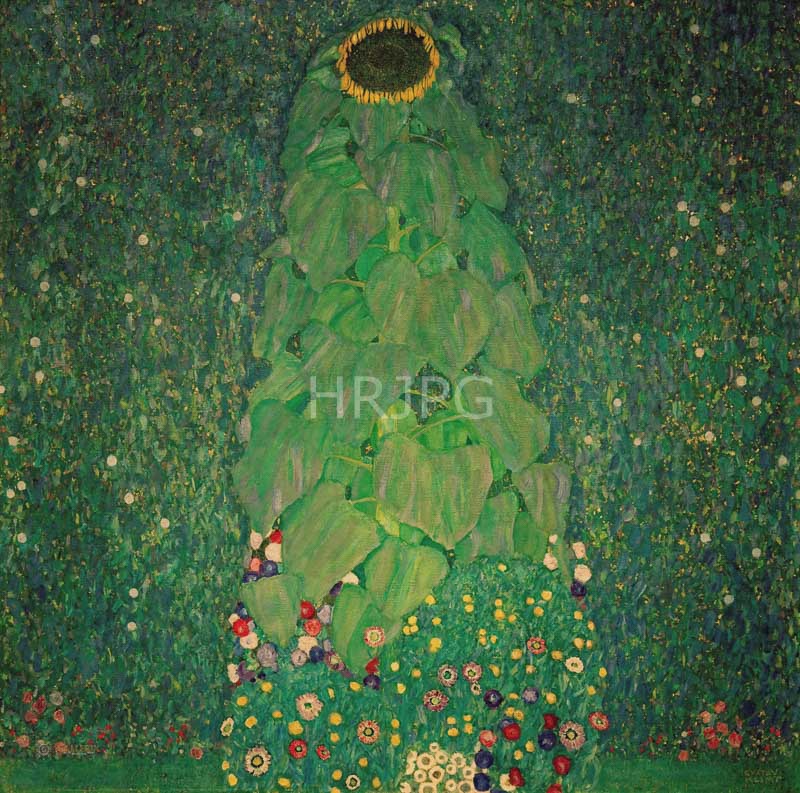
The monumental oil painting "The Sunflower" was created by the Austrian master Gustav Klimt in 1907, during the absolute pinnacle of his "Golden Phase." This work is widely considered one of the most innovative and significant landscapes of the early 20th century, as it essentially treats a single botanical subject as if it were a royal portrait. Unlike the expressive and agonized sunflowers of Vincent van Gogh, Klimt’s version is a study in stoic, decorative reverence. This painting was produced during his summer residency at Lake Attersee, a period where Klimt sought a "synthesis" between his intricate ornamental style and the raw, unmediated beauty of the natural world.
Technically, the composition is anchored by the massive, upright form of a single sunflower, which occupies the central vertical axis of the square canvas. Klimt utilizes a sophisticated version of Pointillism to render the surrounding garden, applying dense "dabs" of shimmering green, violet, and gold paint. These colors create a "tapestry-like" background that vibrates with light, effectively flattening the space and pushing the subject to the very front of the picture plane. The leaves of the sunflower are rendered as a cascade of dark, stylized shapes that resemble the patterned robes found in his contemporary portraits, such as "The Kiss." This "anthropomorphizing" of the plant is a key technical detail; the sunflower possesses a monumental, almost human-like posture, standing as a sentinel within a shimmering, decorative paradise. The high horizon line and the compressed perspective reflect Klimt's fascination with Japanese prints, where the surface texture and rhythmic organization of form take precedence over traditional three-dimensional depth.
Historically, "The Sunflower" represents a significant shift in Klimt’s landscape style toward a more detached and symbolic observation of nature. This was a time when the Vienna Secession was promoting the idea of "total art," and Klimt applied this philosophy by transforming a simple garden scene into a sacred, icon-like object. Some art historians have suggested that the sunflower is a symbolic representation of his lifelong companion, Emilie Flöge, characterized by its elegant, elongated form and the protective "aura" of the surrounding blossoms. The work reflects the "Fin-de-Siècle" obsession with the eternal rhythms of growth and decay, where the natural world is seen as a mirror of human emotions and spiritual aspirations.
Art criticism has long lauded "The Sunflower" for its "extraordinary jewel-like intensity." Critics such as Frank Whitford have noted that Klimt’s landscapes are "purely optical experiences," and this painting is often cited as the ultimate example of his ability to see the sacred within the mundane. The work is praised for its "decorative gravity," proving that Klimt could achieve a sense of monumental power without the need for gold leaf or complex mythology. Contemporary scholars highlight the painting as a masterpiece of European Symbolism, noting its profound influence on the later developments of modern design and abstraction. Today, it remains a cornerstone of the Belvedere collection in Vienna, standing as a testament to Klimt's unique ability to transform the world into a shimmering, eternal tapestry of color and light.