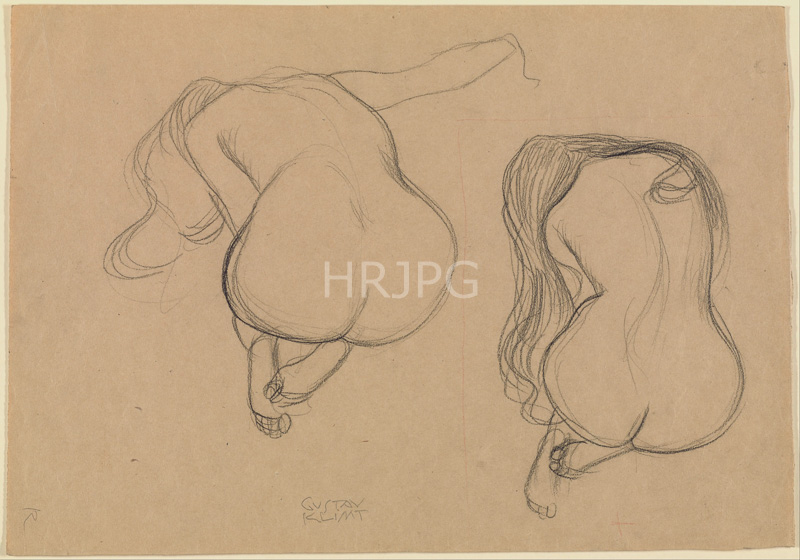
These two evocative graphite sketches, "Two Studies of a Seated Nude with Long Hair," were produced by Gustav Klimt around 1901 to 1902. They were created during the formative years of his "Golden Phase" and the peak of the Vienna Secession movement. At this time, Klimt’s studio was a place of constant graphic exploration, where he sought to map the "rhythms of the human body" from every possible angle. These studies were central to his daily practice, allowing him to explore the "fluidity" and psychology of the female form before incorporating these figures into his larger, more decorative allegorical oil paintings such as the "Beethoven Frieze" or "Medicine."
Technically, the work is characterized by its "nimble and fluid lines" and its focus on anatomical simplified form. Klimt depicts the seated nude from two slightly different angles, capturing the way the weight of the body shifts and the way the long hair flows rhythmically down the back. He utilizes a singular, continuous contour line to define the figures, varying the pressure of the graphite to suggest volume and the soft texture of skin. There is a remarkable sense of "psychological introspection" in these studies; the figures are not posed for the viewer but seem caught in a private, unobserved moment of quietude. By choosing to depict the nude from the back or in profile, Klimt emphasizes the "internal world" of the subjects, turning the body into a landscape of form and shadow. The use of white space around the figures is strategic, creating a sense of weightlessness and ethereal beauty that highlights the artist's ability to convey monumental presence through the most minimal graphic means. These drawings demonstrate his mastery of "linear expression," where the line itself becomes a carrier of both physical description and emotional mood.
Historically, these studies reflect the "liberation of the body" that was a primary goal of the Viennese avant-garde. Klimt’s interest in depicting women in natural, unidealized states was seen as a radical statement in a society that preferred to keep the domestic and biological realities of humanity hidden. This period saw Klimt influenced by the "expressive honesty" of international movements, leading him to move away from the static, academic nude toward a more "fluid and modern" representation of femininity. These private drawings were essential to his development, acting as the foundation for the anatomical truth that underpinned his most famous decorative works.
Art criticism has long identified Klimt’s nude studies as some of the most innovative and important graphic works of the early 20th century. Critics like Alessandra Comini have argued that these works show Klimt at his most "sincere," revealing a deep empathy for his models. The sketches are praised for their "melodic quality" and their ability to convey a sense of "cosmic rhythm." Today, "Two Studies of a Seated Nude with Long Hair" is regarded as a masterclass in modern draftsmanship, proving that Klimt's genius was not dependent on gold leaf or complex ornamentation, but was rooted in his ability to see the extraordinary grace in the simplest human form. It remains a vital reference point for understanding the evolution of the female subject in the early 20th century.