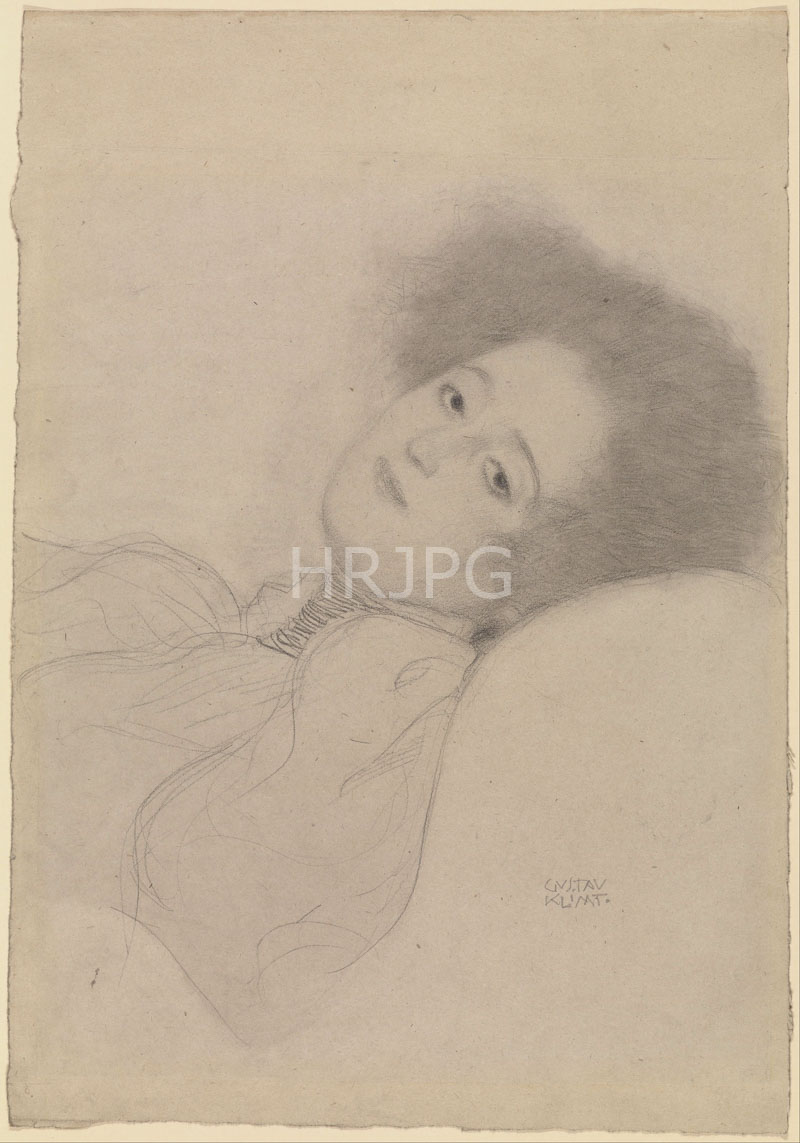
This delicate pencil and graphite drawing, "Portrait of a Young Woman," was executed by Gustav Klimt sometime after 1890. It belongs to a pivotal transitional period in his career, where he began to move away from the rigid academic realism of his early years toward the more personal, sensitive, and Symbolist graphic style that would define the rest of his life. During the late 1880s and early 1890s, Klimt was already a renowned decorative painter, but it was through these private drawings that he began to experiment with the "linear elegance" and psychological depth that would later characterize the Vienna Secession movement.
Technically, the work is a masterclass in the use of "fine line" to define both volume and character. Klimt captures the young woman in a three-quarter profile, focusing his attention on the soft contours of her facial features and the intricate volume of her hair. There is a remarkable sense of "subtlety" in his handling of the pencil; he uses varying weights of line to suggest shadow and depth without relying on heavy cross-hatching. The hair is rendered with a sense of rhythmic flow, demonstrating his early interest in the decorative potential of natural forms. The subject's expression is one of quietude and introspection, which marks a significant departure from the more static and formal societal portraits of the era. By omitting any background detail, Klimt forces the viewer to focus entirely on the "inner life" of the subject, utilizing the negative space of the paper as a luminous field that enhances the figure's delicate presence. This approach to "linear portraiture" is highly innovative, anticipating the anatomical simplifications and psychological honesty of his mature graphic style.
From a historical perspective, the early 1890s were a period of intense artistic fermentation in Vienna. Klimt was witnessing the collapse of traditional artistic hierarchies and was increasingly influenced by the Symbolist movements in England and Belgium. This drawing reflects his search for a more "authentic" artistic voice, one that could convey the complexities of the modern human experience. This period saw the birth of the "Klimt Group" and the early discussions that would lead to the founding of the Secession in 1897. These drawings were essential to his development, serving as a laboratory for the formal and psychological experiments that would eventually appear in his large-scale paintings.
Art criticism has frequently highlighted the "technical purity" of these early drawings. Critics like Christian Nebehay have argued that Klimt's draftsmanship from the 1890s shows his transition from a "virtuoso of realism" to a "master of the spirit." The drawing is praised for its "melodic quality," where the line itself becomes a form of artistic expression. Today, "Portrait of a Young Woman" is regarded as a vital document for understanding Klimt's artistic evolution, proving that his later stylized aesthetic was rooted in a deep and profound mastery of traditional technique. It remains a moving and beautiful example of his ability to see the extraordinary grace within a simple human form, standing as a precursor to the modern figurative art of the 20th century.