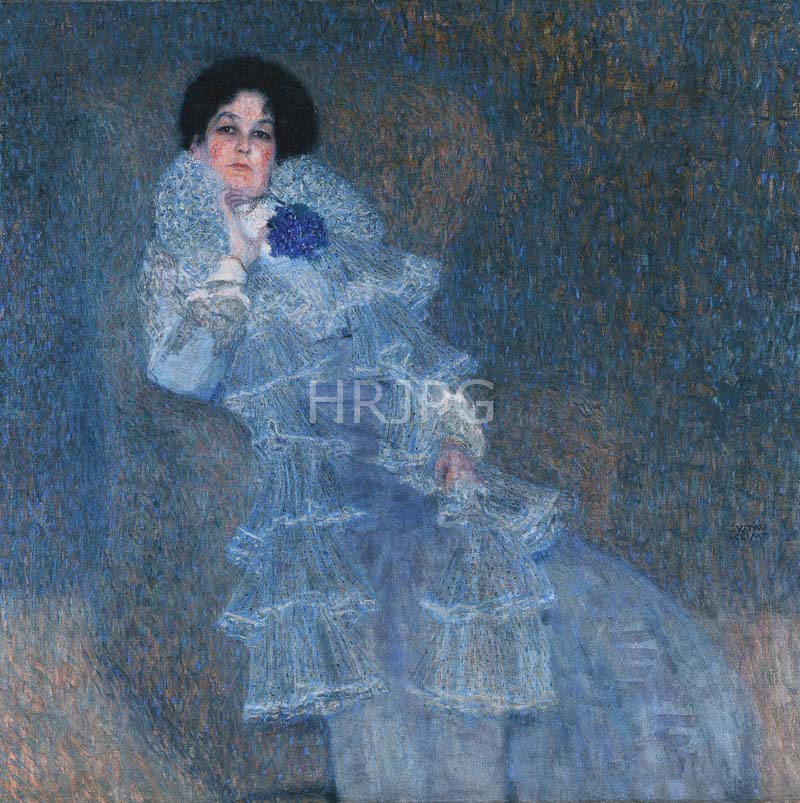
The stunning "Portrait of Marie Henneberg" was created by Gustav Klimt between 1901 and 1902. This work is a classic example of his late Symbolist portraiture, produced during the years when he was refining the "mosaic style" that would eventually lead to his famous Golden Phase. Marie Henneberg was the wife of the prominent photographer Hugo Henneberg, a founding member of the Vienna Secession. This relationship underscores the shared creative goals between the world of avant-garde painting and modern photography in Vienna. The portrait is noted for its cool, atmospheric color palette and its profound sense of psychological presence, capturing the subject in a moment of dreamlike suspension.
Technically, the painting is a masterclass in the use of cool blues, whites, and silvers to create an "ethereal" atmosphere. Marie is depicted in a voluminous, layered dress that occupies a large portion of the lower canvas, rendered with rhythmic, Pointillist brushstrokes. This technique allows Klimt to emphasize the decorative and textured surface of the painting over traditional three-dimensional depth. The subject’s face and hands are modeled with soft, delicate transitions, creating a sense of "luminous skin" that contrasts with the more abstract, patterned background. The composition is built on the interplay of vertical and horizontal elements, with the subject seated in a way that suggests both stability and fleeting elegance. The background features subtle, geometric motifs that seem to emerge from and recede into the atmospheric haze, a characteristic of the Secessionist search for "total harmony." By utilizing a compressed perspective, Klimt brings the viewer into close proximity with the subject, while the cool color scheme maintains a sense of sophisticated distance and psychological introspection.
Historically, the Henneberg family were central figures in the intellectual life of the city. Their villa, designed by Josef Hoffmann, was a laboratory for modern Viennese living, and this portrait was a key element of that aesthetic environment. The work reflects the "Fin-de-Siècle" move away from the materialism of the Ringstrasse toward a more subjective and symbolic representation of reality. This was a period when Klimt was increasingly influenced by the works of Jan Toorop and the Belgian Symbolists, whose focus on line and mood encouraged him to find a more "spiritual" quality in his own portraiture.
Art criticism has long identified the "Portrait of Marie Henneberg" as one of Klimt’s most successful atmospheric works. Critics such as Jane Kallir have noted the "shimmering, jewel-like surface" of the painting, describing it as a masterpiece of late-century design. The painting is praised for its ability to convey a sense of "internal focus," where the subject seems to be caught in a private, meditative state. Modern scholars often point to the "blue and white palette" as a radical choice for the time, prefiguring the later developments of Expressionism. Today, it remains a cornerstone of the Moritzburg Museum collection, celebrated for its ability to transform a societal portrait into a profound and beautiful meditation on the ethereal nature of the human spirit.