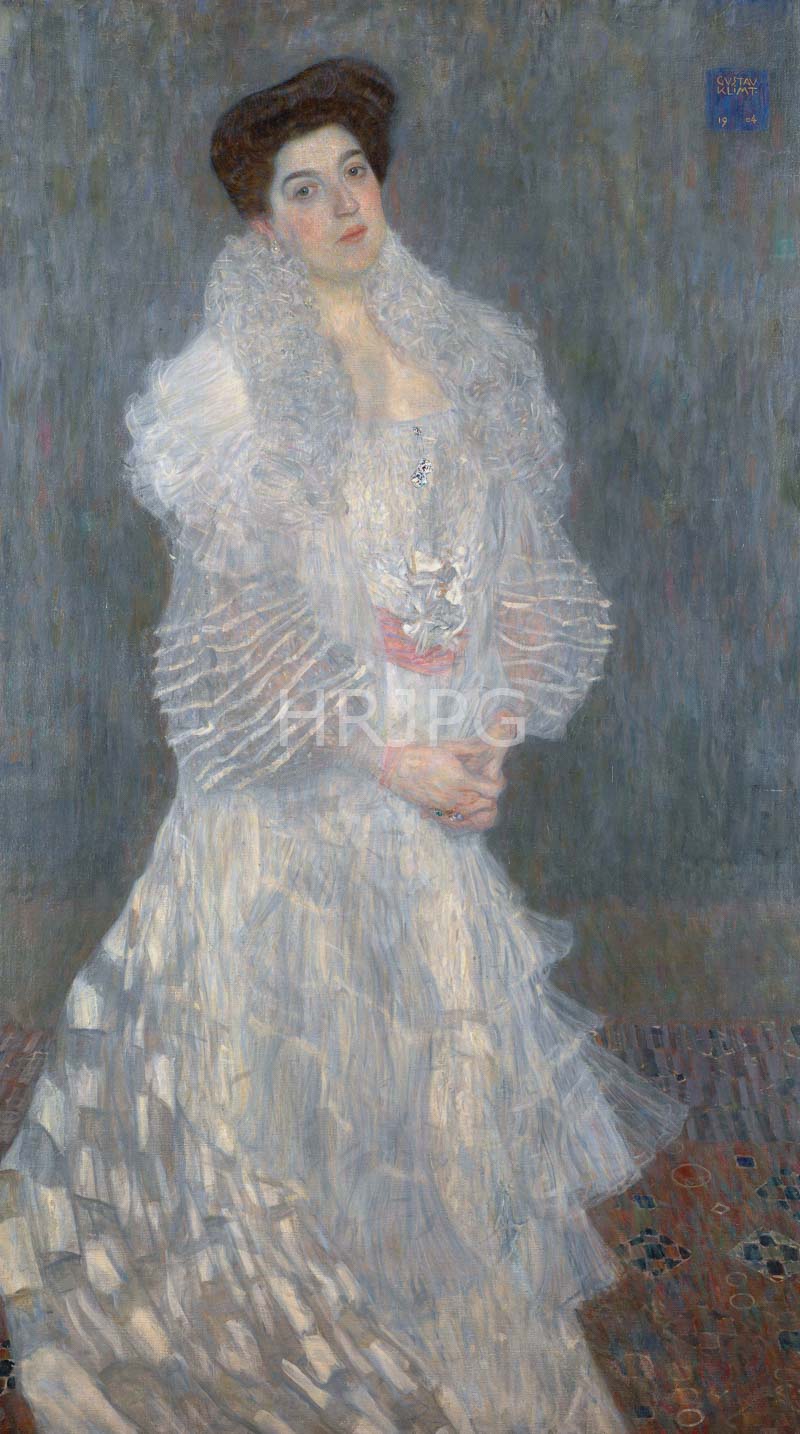
The elegant "Portrait of Hermine Gallia" was painted by Gustav Klimt between 1903 and 1904. This work is a premier example of his transition from academic portraiture to the highly stylized, atmospheric aesthetic of the Vienna Secession. Hermine Gallia was the wife of a wealthy industrialist and a member of one of the leading patron families of the Wiener Werkstätte. This commission illustrates the close ties between the Viennese avant-garde and the Jewish upper middle class, who sought to express their modern social status through innovative art. The portrait is renowned for its delicate handling of light and its sophisticated blend of traditional modeling with modern decorative organization.
Technically, the painting is dominated by its sophisticated "misty" or atmospheric quality. Hermine is depicted in a voluminous white gown, which Klimt renders with thousands of tiny, shimmering dabs of paint—a technique influenced by the Pointillism of Seurat and the Impressionism of Whistler. This approach creates a sense of "luminous movement," as if the fabric itself is vibrating with light. The subject’s skin is modeled with extreme sensitivity, using soft transitions of color to suggest a refined, aristocratic aura. The composition is structured around the contrast between the detailed figure and the more abstract, patterned background. The floor features a subtle, geometric design that anticipates the more aggressive patterns of his later "Golden Phase." By focusing on the interplay of cool tones and soft textures, Klimt creates a sense of psychological presence that is both intimate and distant. The square format of the canvas provides a sense of modern balance, free from the hierarchical constraints of traditional vertical portraiture, and emphasizes the decorative unity of the subject and her environment.
Historically, the Gallia family were central figures in the development of "Modern Vienna." Their apartment was a showcase for Secessionist design, and this portrait was intended to be the centerpiece of that environment. The work reflects the "Secessionist ideal" of beauty as something refined, cerebral, and harmonious. It was produced at a time when Klimt was increasingly moving away from public allegories to focus on the private world of his wealthy patrons, allowing him to experiment with the formal properties of light and texture in a controlled, domestic setting.
Art historians have praised the "Portrait of Hermine Gallia" for its extraordinary technical refinement. Critics have often noted the "ethereal beauty" of the work, describing it as a "symphony in white." The critic Frank Whitford highlighted Klimt’s ability to capture the "shimmering atmosphere" of a room through purely optical means. Modern scholarship often points to this painting as a crucial precursor to his later portraits of Adele Bloch-Bauer and Emilie Flöge, noting how the "mosaic of brushstrokes" seen here would eventually evolve into his famous golden patterns. Today, it is regarded as one of the highlights of the National Gallery’s collection in London, standing as a testament to Klimt's ability to transform a traditional commission into a timeless investigation of light, texture, and social identity.