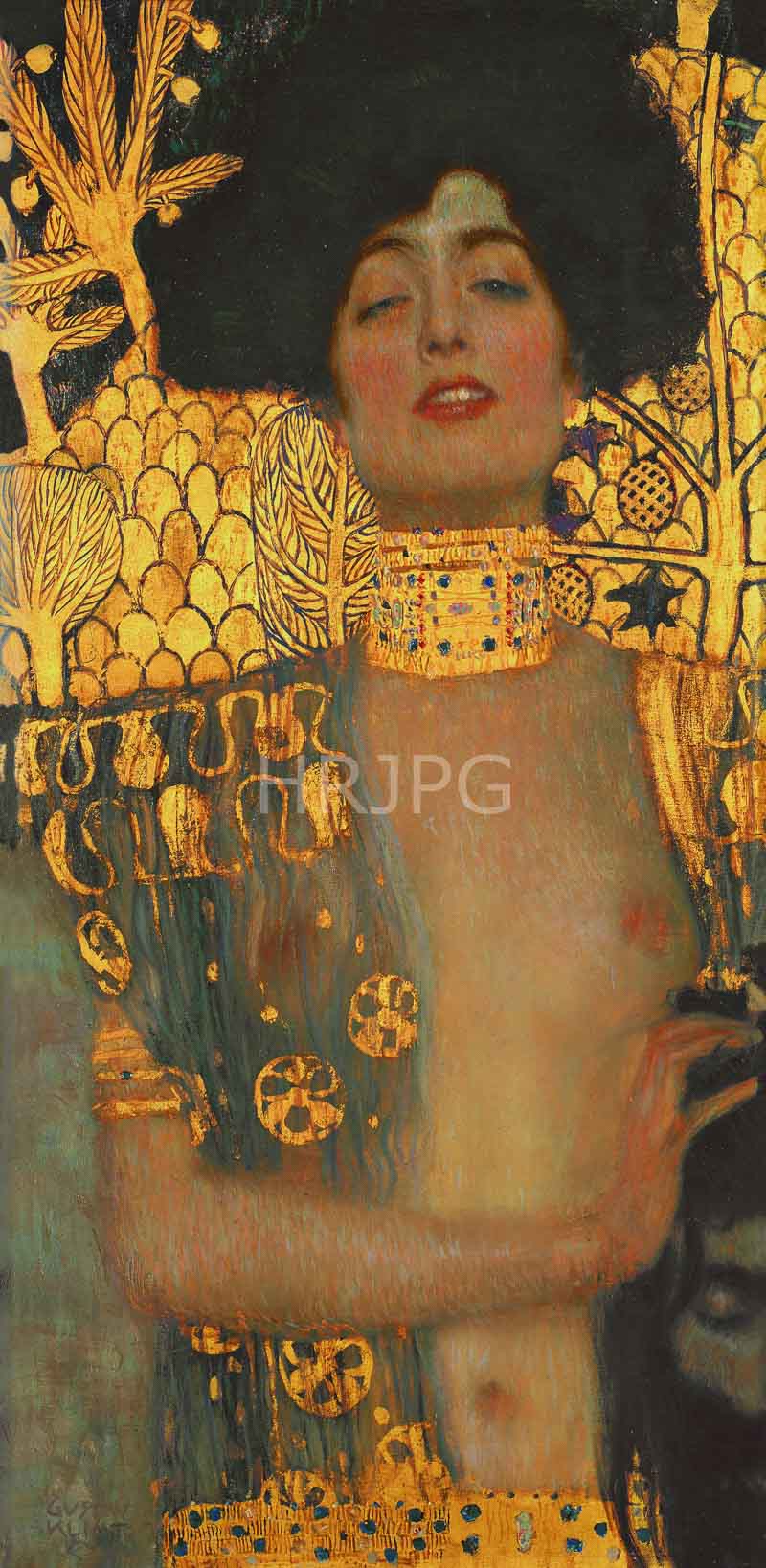
The masterpiece "Judith and the Head of Holofernes" (also known as Judith I) was painted by the Austrian artist Gustav Klimt in 1901. This painting marks one of the most significant early entries into his "Golden Phase," a period characterized by the lavish use of gold leaf and complex ornamentation inspired by Byzantine mosaics. Unlike traditional depictions of the biblical Judith as a virtuous or heroic figure, Klimt reimagines her as a contemporary "femme fatale," a seductive and dangerous woman whose power is rooted in her sexuality. This subversion of biblical narrative was a hallmark of the Vienna Secession, reflecting the era's deep preoccupation with the relationship between desire and destruction.
Technically, the composition is a stunning example of Klimt’s ability to synthesize figurative realism with flat, decorative abstraction. Judith’s face and torso are rendered with soft, three-dimensional modeling, capturing a state of ecstatic or post-coital bliss. However, her body is encased in a rigid, two-dimensional frame of gold leaf and intricate patterns. The background features stylized trees and geometric motifs that push the figure to the very front of the picture plane. A striking technical detail is the placement of Holofernes' head; it is cropped at the bottom right corner, partially obscured, which shifts the viewer’s focus entirely to Judith’s psychological state rather than the violence of the act. The heavy use of gold serves not just as decoration but as a "sacred shroud," elevating the eroticized subject to the status of a secular icon. The contrast between the luminous skin and the dark, metallic gold creates a visual vibration that heightens the painting’s sense of luxury and mystery.
Historically, this work reflects the intellectual climate of "Fin-de-Siècle" Vienna, where the works of Sigmund Freud were beginning to influence the artistic representation of the subconscious. Judith is depicted here as a symbol of the "liberated woman," who uses her sensuality as a weapon against patriarchal authority. The model for Judith is often identified as Adele Bloch-Bauer, a prominent member of the Viennese Jewish elite and a close friend of the artist, illustrating the intersection between Klimt’s private life and his public artistic provocations. The original frame, crafted by Klimt’s brother Georg, was also integral to the work, emphasizing the concept of the Gesamtkunstwerk or total work of art.
Art criticism has long identified "Judith I" as a landmark of modern Symbolism. Critics such as Frank Whitford have noted the "nervous elegance" of the work, describing Judith as the embodiment of the decadent spirit of the age. For years, the public mistakenly identified the painting as "Salome," a testament to how effectively Klimt had captured the archetype of the dangerous seductress. Today, it remains one of the most iconic images in the Belvedere collection, celebrated for its provocative blend of eroticism, power, and decorative splendor. It continues to be a vital reference point for understanding the evolution of the female subject in early 20th-century art.