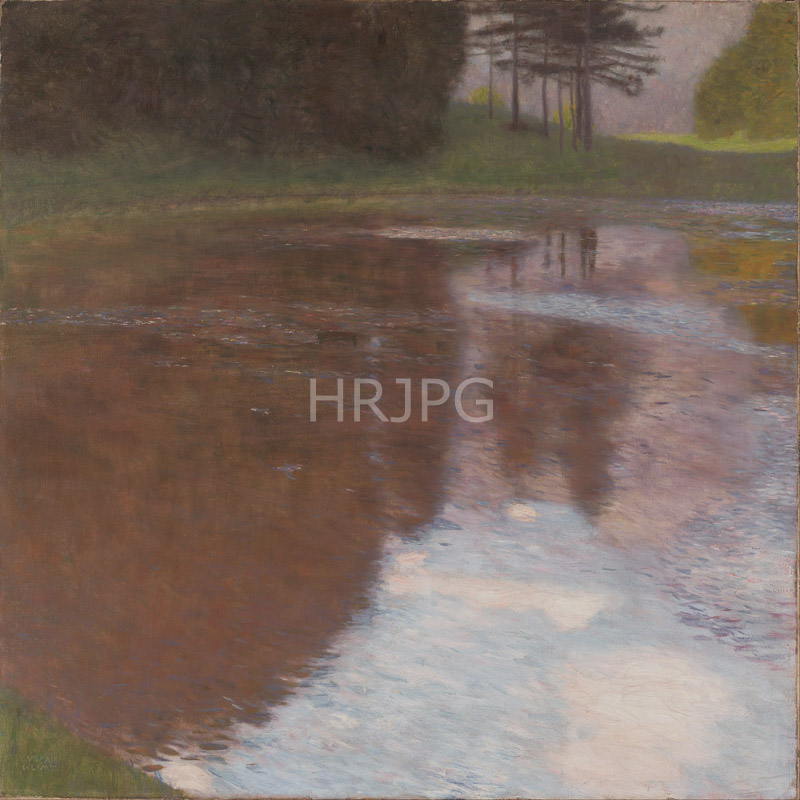
The serene landscape painting "Tranquil Pond" (also known as "Egelsee near Golling") was created by Gustav Klimt around 1899. This work belongs to his early landscape period, a time when he was just beginning to establish his nearly two-decade-long tradition of summer painting in the Austrian countryside. In 1899, Klimt was a founding member of the Vienna Secession and was actively seeking a "new artistic path" that would allow him to escape the controversies of his public commissions in the city. "Tranquil Pond" is a quintessential product of this escape, demonstrating his early innovative approach to light, reflection, and the immersive qualities of nature.
Technically, the work is defined by its "Impressionistic focus" on the play of light and its soft, atmospheric color transitions. Klimt utilizes a wide range of greens, blues, and earth tones to render the pond and the surrounding foliage, focusing on the way the water’s surface reflects the sky and the trees. The brushstrokes are small and rhythmic, creating a vibrating, textured surface that captures the shimmering energy of the scene without relying on traditional linear perspective. The composition is quiet and balanced, with a low horizon line that emphasizes the expanse of the water and the sky. This "serene atmosphere" is achieved through a meticulous application of color that anticipates his later, more "patterned and decorative" nature views. The way the reflections in the pond begin to merge with the actual foliage suggests an early move toward the "flattened" spatial organization that would define his mature style. The painting demonstrates a sophisticated understanding of the "mood" of a landscape, prioritizing the emotional resonance of the scene over its topographic details.
Historically, 1899 was a year of profound creative output for Klimt, marking the first of his summer trips with the Flöge family. It was during these retreats that he found the "tranquility" that he could not achieve in Vienna. The work reflects the influence of the "Scandinavians" and "Belgians" on the Secessionist aesthetic, particularly their focus on the poetic and spiritual qualities of the landscape. This period saw Klimt moving away from the historical and allegorical toward a more subjective and personal view of the world, reflecting the broader "Fin-de-Siècle" move toward Symbolism.
Art historians and critics have long marveled at the "modernity" of "Tranquil Pond." Critics such as Frank Whitford have noted the "obsessive observation" and the "ornamental harmony" of the work, describing it as a landscape that has been "filtered through a poetic lens." The painting is celebrated today for its "tranquil beauty," a quality that is characteristic of his early nature studies. Modern scholars highlight the work as a crucial link in the evolution of modern landscape art, proving that Klimt’s brilliance was rooted in his ability to see the world as a shimmering, decorative paradise. It remains a cornerstone for understanding the origins of his late landscape style and his enduring fascination with the rhythms of the natural world.