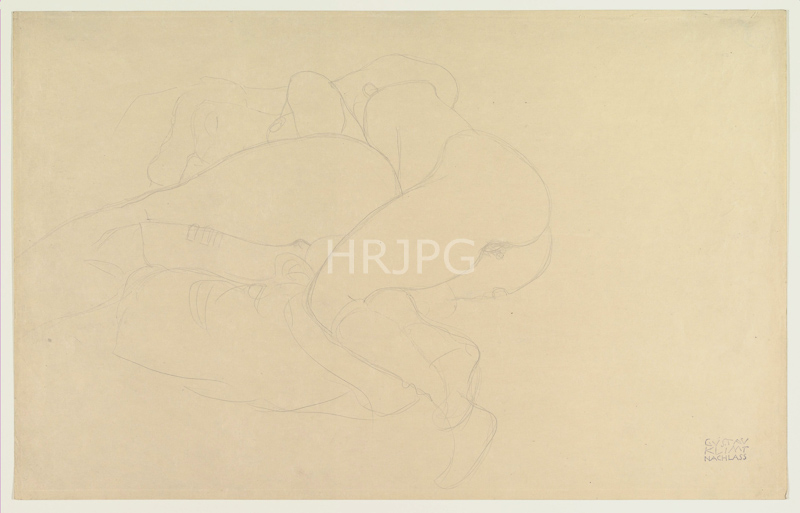
This masterful graphite drawing, titled "Two Women Reclining," was produced by the Austrian artist Gustav Klimt approximately between 1912 and 1913. It belongs to his late mature period, a time when he focused almost exclusively on the raw and intimate potential of graphic art within his private studio practice. Klimt’s studio was a sanctuary where models could move and lounge freely, allowing the artist to capture spontaneous gestures and moments of shared repose. This drawing is a classic example of his search for "modern beauty," where the decorative grace of his earlier years is replaced by a more direct and unvarnished view of the female form.
Technically, the work is a study in "rhythmic curves" and anatomical simplified form. Klimt utilizes long, sweeping strokes of the pencil to define the contours of the two reclining figures, creating a sense of volume and weight through the sheer elegance of the drawing. There is a remarkable sense of "domestic intimacy" in the composition; the limbs of the two women are intertwined in a way that creates a complex, rhythmic pattern across the page. The shading is minimal, used only to suggest the softest transitions of light across the skin and to ground the figures in space. By choosing to depict two figures together, Klimt explores the formal and psychological dynamics of connection. The use of the white paper as a luminous field enhances the sense of weightlessness and ethereal beauty, making the figures appear almost as if they are floating in a dreamlike void. This approach reflects the influence of the younger Expressionist generation, who encouraged Klimt to find a more nervous and emotionally honest quality in his own late draftsmanship.
From a historical perspective, these late drawings reflect the changing social and moral landscape of Vienna during the pre-war years. While the city outside was becoming increasingly turbulent, Klimt’s studio remained a place of constant artistic experimentation. This period saw Klimt moving away from the "decorative armor" of his gold paintings toward a more "vulnerable" and human-centered aesthetic. These private drawings were essential to his daily practice, serving as a vital laboratory for the formal experiments that would appear in his final unfinished paintings, such as "The Bride."
Art historians and critics have consistently highlighted the "modernity" of Klimt’s late figure studies. Critics like Alessandra Comini have argued that these works show Klimt at his most "authentic," revealing a deep empathy for his models. "Two Women Reclining" is praised for its "melodic line" and its ability to convey a sense of monumental beauty through the most minimal means. It is regarded today as a cornerstone of modern figurative art, demonstrating the shift from the decorative traditions of the 19th century to the psychological and expressive honesty of the 20th century. The drawing remains a powerful testament to Klimt’s enduring fascination with the elegance and mystery of the human form in states of shared relaxation.