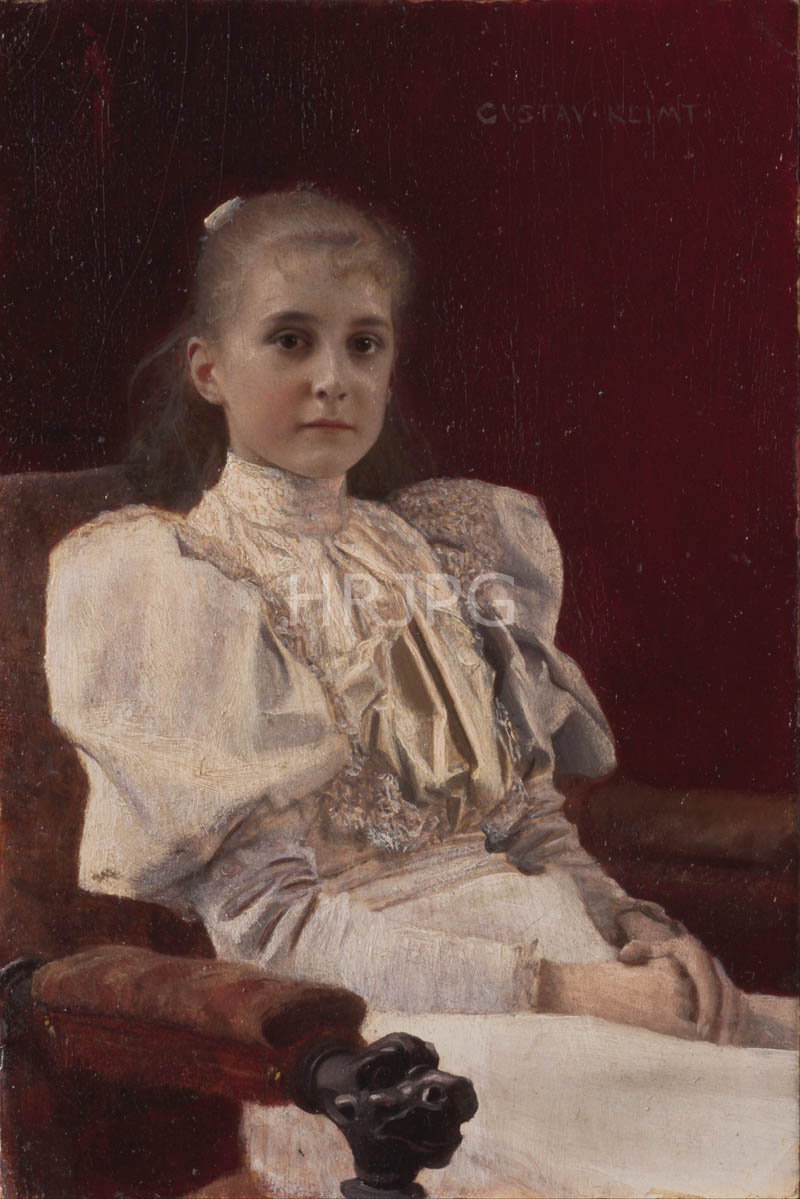
The exquisite oil portrait "Seated Young Girl" was created by Gustav Klimt around 1894, during his early period of academic Realism. This work is a premier example of Klimt’s extraordinary technical skill before he became the leader of the Vienna Secession and developed his famous "Golden Phase." At this time, Klimt was already a highly successful painter of historical murals and societal portraits, recognized for his ability to capture the textures and personality of his subjects with photographic precision. This painting serves as a vital record of his formal training and his refined sensitivity to the nuances of light and character during the late 19th century.
Technically, the work is defined by its meticulous attention to detail and its sophisticated lighting. The young girl is seated in a stately, dark armchair, her small form emphasized by the voluminous white lacy dress she wears. Klimt utilizes a wide range of whites and creams to render the complex textures of the lace and silk, capturing the play of light across the delicate fabric with remarkable subtlety. The composition is traditional and formal, yet the girl’s direct gaze and slightly reserved expression provide a sense of individual characterization that transcends mere academic flattery. The dark, atmospheric background serves to push the luminous figure forward, creating a strong sense of three-dimensional presence. This focus on "precisely modeled forms" and clear lighting represents a complete contrast to the flattened, decorative surfaces of his later work, proving that his eventual move toward abstraction was a deliberate choice rather than a lack of foundational skill.
Historically, 1894 was a year of transition for Klimt. He was still a favorite of the Viennese establishment, working on major commissions like the Great Hall of the University of Vienna. However, this portrait shows the early signs of the psychological depth that would eventually lead him to break with tradition. The girl’s solemnity reflects the "Fin-de-Siècle" preoccupation with the complexities of childhood and the internal world of the subject. The work reflects the high-society aesthetics of the Ringstrasse era, a culture that valued order, elegance, and traditional beauty, just before the radical upheavals of modernism.
Art historians have consistently praised "Seated Young Girl" for its "masterful draftsmanship." Critics have noted the "Old Master" quality of the painting, comparing Klimt’s handling of the white dress to the works of Velázquez or Whistler. The painting is celebrated today for its "tender realism," a quality that is often overlooked in discussions of his later, more famous decorative works. Modern criticism highlights the painting as a crucial document of Klimt’s evolution, demonstrating that his brilliance was rooted in a profound understanding of classical technique. It remains a beloved work in the Belvedere collection, standing as a testament to the artist's ability to see and represent the extraordinary grace within a quiet, domestic moment.