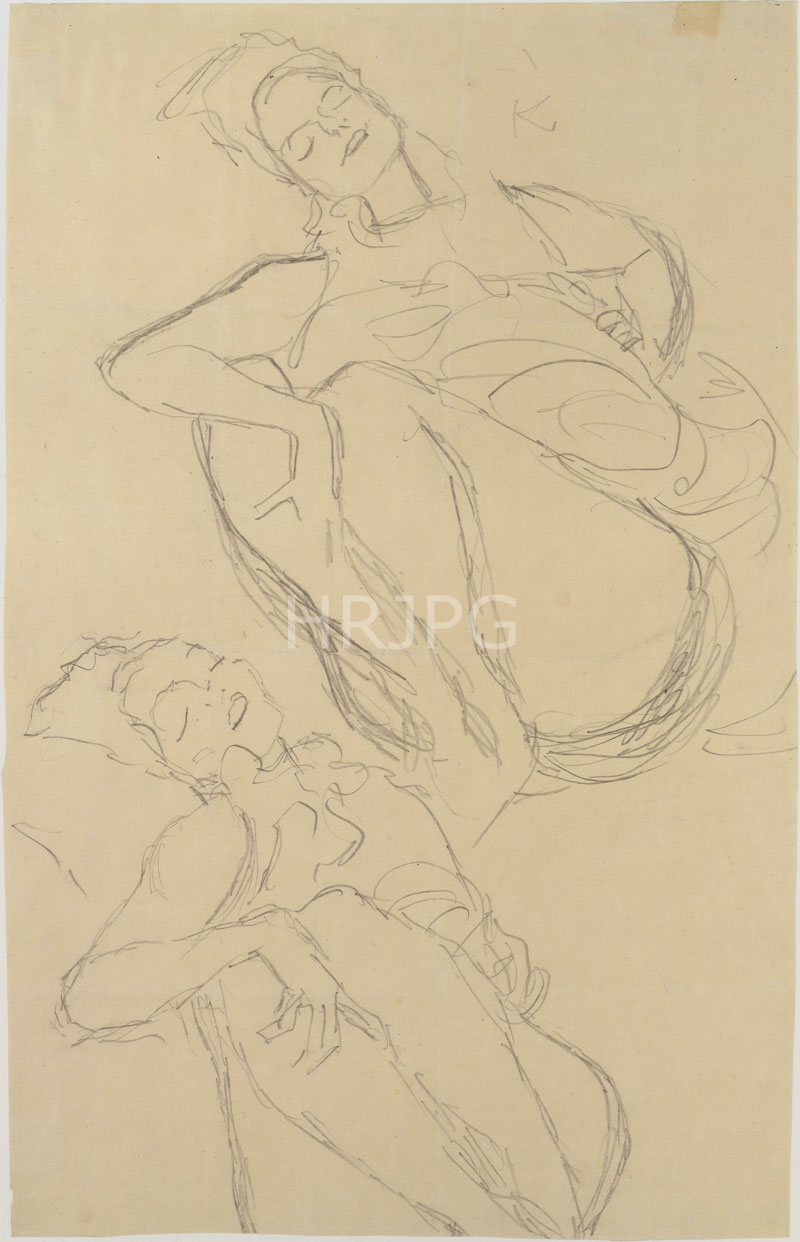
The evocative pencil drawing "Two Studies for a Crouching Woman" was executed by the Austrian master Gustav Klimt around 1914 to 1915. During this late mature period, Klimt moved away from the monumental gold leaf allegories of his middle years to explore the raw and expressive potential of the human form through the medium of graphite. These studies were part of his daily studio practice, where he focused on capturing the "truth" of the body in states of physical tension and emotional weight. This work serves as a vital preparatory investigation for his complex late allegorical compositions, illustrating his ongoing search for a modern graphic language that could convey internal psychological depth.
Technically, the composition is centered on the rhythmic and contorted poses of the crouching figure, viewed from two different angles. Klimt utilizes a singular, confident line that varies in pressure to suggest volume and shadow without the need for heavy hatching. The "physical tension" is captured through the sharp angles of the limbs and the hunched posture, which creates a sense of compressed energy and internal focus. There is a remarkable sense of movement within the static poses, achieved through the fluid yet brittle quality of the line work. The artist omits any background or environmental detail, utilizing the negative space of the paper as a luminous field that emphasizes the silhouette of the body. This anatomical simplification reflects his move toward an "essentialist" draftsmanship, where the contour itself becomes the primary vehicle for emotional expression, echoing the influence of the younger Expressionist generation.
Historically, this work was produced during a period of immense social and personal transition for Klimt, marked by the onset of World War I. The somber and introspective mood of the crouching figures reflects the growing darkness of the era and the collapse of the old Austro-Hungarian world. Klimt’s studio remained a sanctuary where he could explore these universal themes of human vulnerability and shared destiny. These private drawings were essential to his late style, allowing him to experiment with the nervous energy and psychological honesty that would characterize his final, unfinished oil paintings such as "The Bride."
Art criticism of the late 20th century has consistently highlighted the "modernity" of Klimt’s late figure studies. Critics like Jane Kallir have argued that these works show Klimt at his most "authentic," free from the decorative armor of his public commissions. The drawing is praised for its "melodic line" and its ability to convey monumental presence through the most minimal means. It is regarded today as a cornerstone of modern graphic art, demonstrating the shift from 19th-century academic realism to the more subjective and expressive honesty of the 20th century. The work remains a powerful testament to Klimt’s enduring fascination with the elegance and mystery of the human form in states of deep introspection.