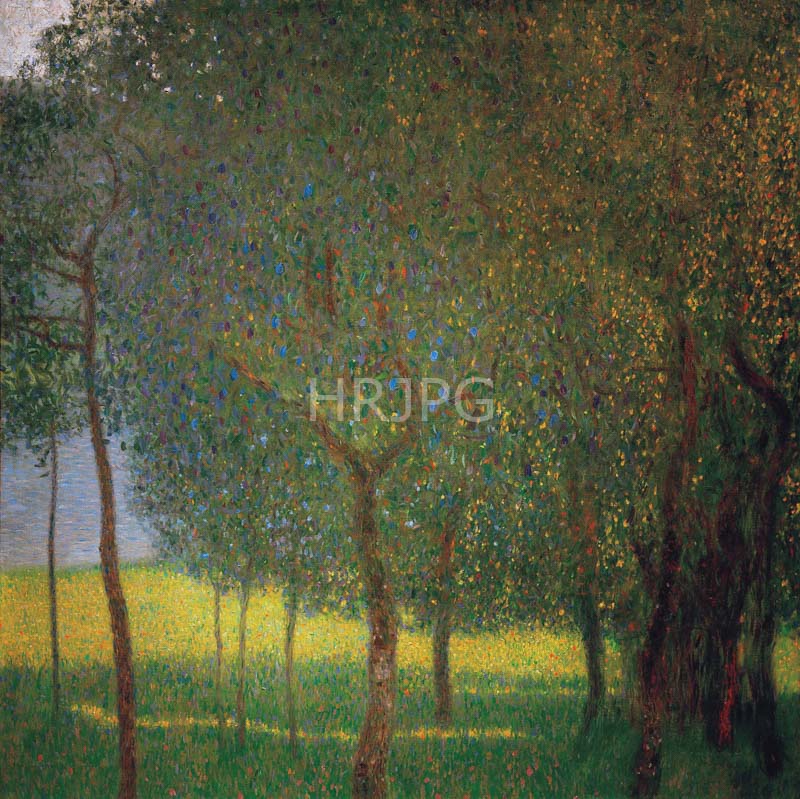
The renowned oil painting "Fruit Trees" (also known as "Fruit Trees on Lake Attersee") was created by Gustav Klimt in 1901. This work is a cornerstone of Klimt’s early landscape period, marking the beginning of his nearly twenty-year tradition of summer painting at the lake. During this time, Klimt was a founding member of the Vienna Secession and was actively seeking to revolutionize Austrian art by moving away from historical academicism toward a more personal, decorative style. "Fruit Trees" serves as a foundational work in this transition, demonstrating his early experiments with Pointillism and the "flattened" spatial organization that would later become a hallmark of his most famous canvases.
Technically, the painting is characterized by its meticulous "foliage patterning" and its rigid square composition. Klimt organizes the scene so that the fruit trees occupy the central field, their branches and leaves rendered with thousands of tiny, jewel-like dabs of paint. This technique, influenced by the French Neo-Impressionists, allows Klimt to create a shimmering, textured surface that captures the vibrant energy of a summer meadow. The color palette is a luminous arrangement of greens, golds, and whites, with the fruit appearing as small, rhythmic accents of color. The perspective is purposefully compressed; the golden meadow in the foreground and the dense foliage of the trees merge into a single decorative plane, echoing the aesthetic of a tapestry or a mosaic. This approach was heavily inspired by Japanese prints and the concept of the Gesamtkunstwerk, where every element of the natural world is treated with equal decorative importance. The lack of a traditional horizon or human presence emphasizes the eternal, static beauty of the garden, transforming a rustic scene into a highly organized and stylized work of art.
Historically, the year 1901 was a period of intense public debate surrounding Klimt’s work, particularly his controversial "Faculty Paintings." His retreats to the Attersee provided a necessary mental escape, allowing him to focus on the "tranquil rhythms" of nature. This painting reflects the refined, aestheticized view of nature held by the Viennese elite, who saw the garden as a sanctuary of order and beauty. It was during these summers that Klimt developed his unique "square format," which he believed provided a more balanced and modern view of the landscape, free from the hierarchical constraints of traditional horizon-based painting.
Art criticism has long celebrated "Fruit Trees" as a masterpiece of Art Nouveau landscape painting. Critics such as Frank Whitford have noted the "obsessive detail" and the "ornamental harmony" of the work, describing it as a landscape that has been "filtered through the mind of a jeweler." The painting is praised for its ability to balance naturalistic observation with a profound sense of design. Modern scholars often point to this work as a precursor to his "Golden Phase," noting that the "mosaic of leaves" seen here would eventually evolve into the golden patterns of "The Kiss." Today, it is regarded as a vital link in the evolution of modern landscape art, proving that Klimt’s brilliance was rooted in his ability to see the world as a shimmering, decorative whole.