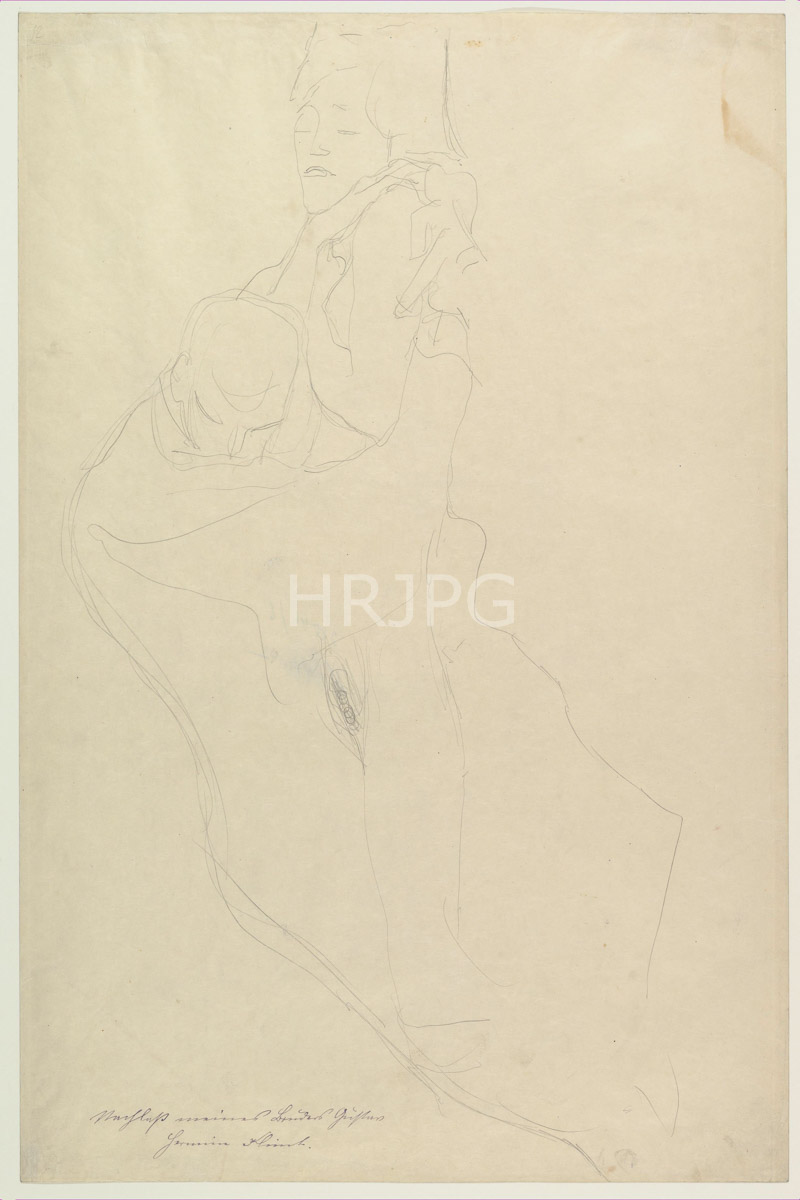
This spontaneous and deeply moving graphite study, titled "The Lovers," was executed by Gustav Klimt approximately between 1913 and 1914. It was produced during his mature graphic period, a time when the artist utilized drawing as a primary means to explore the raw emotional and physical connections between human beings. Unlike his monumental oil paintings which were often veiled in complex allegory, his private drawings allowed for a more direct and unvarnished investigation of intimacy. This specific work is inscribed with the artist’s estate mark, signifying its status as a private treasure that remained in his studio until his death, serving as a vital record of his lifelong fascination with the theme of romantic love.
Technically, the drawing is a masterclass in "linear sensuality" and the expressive potential of the human form. Klimt utilizes a delicate yet remarkably confident pencil line to trace the intertwined bodies of the couple, capturing the weight and surrender of their intimate embrace. The composition is compact and focused, stripping away any environmental context to emphasize the psychological and physical union of the subjects. There is a rhythmic quality to the line work, where the contours of the figures flow into one another, suggesting a loss of individual identity in the moment of connection. Klimt employs very little shading; instead, he relies on the varying pressure of the graphite to suggest the softness of skin and the tension of muscle. The anatomical simplifications—such as the elongated limbs and the soft, rounded forms—reflect his move toward a more modern and expressive style, influenced by the nervous energy of younger artists like Egon Schiele. The use of negative space around the couple enhances the sense of isolation and privacy, making the viewer feel like an intruder upon a sacred, quiet moment.
Historically, "The Lovers" reflects the intellectual climate of "Fin-de-Siècle" Vienna, a culture deeply preoccupied with the depths of human desire and the mysteries of the psyche. Klimt’s erotic drawings were a radical departure from the sanitized, academic art of the era, offering a more honest and sometimes provocative view of human connection. This period in Klimt’s life was marked by a shift toward "International Modernism," where he sought to find universal truths through the most intimate human experiences. These studies were essential to his creative process, acting as the psychological foundation for his late allegorical paintings such as "The Bride."
Art historians and critics have frequently identified these late drawings as the "true heart" of Klimt’s artistic legacy. Critics like Jane Kallir have argued that works like "The Lovers" show Klimt at his most "sincere," free from the decorative "armor" of gold leaf. The drawing is praised for its "lyrical beauty" and its ability to convey profound emotional depth through minimal means. It is regarded today as a landmark in modern figurative art, demonstrating how the line itself could become a vehicle for empathy and existential exploration. The work remains a moving tribute to the power of human connection, encapsulating the intense creative and emotional aura of a city on the brink of profound historical change.