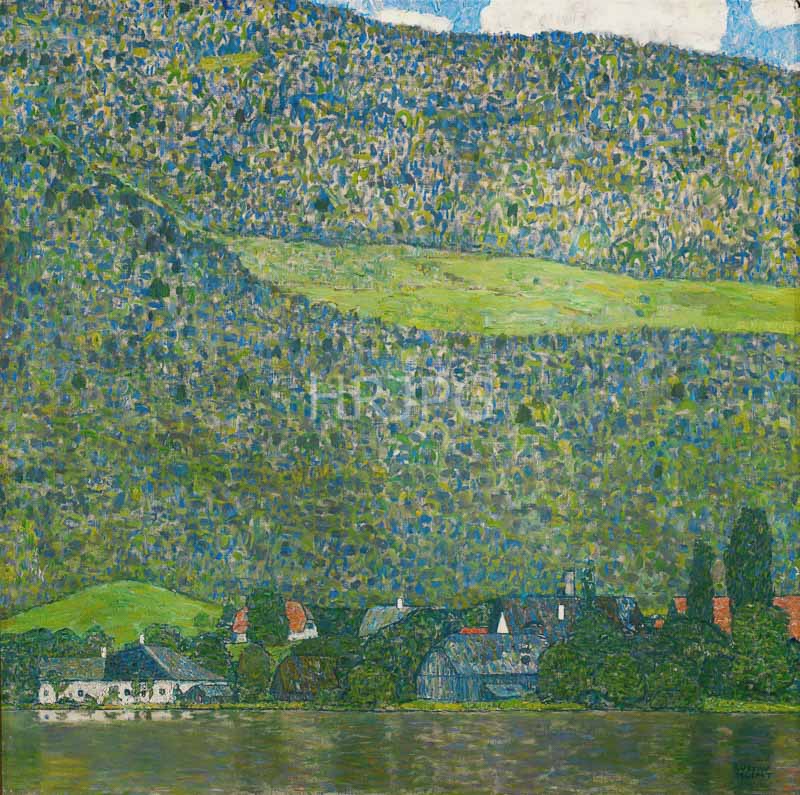
The lush and atmospheric landscape "Litzlberg am Attersee" was painted by the Austrian artist Gustav Klimt between 1914 and 1915. This work belongs to the final phase of Klimt’s landscape series, produced during his summer residencies at Lake Attersee. By this stage in his career, Klimt had moved away from the intense gold ornamentation of his middle years, choosing instead to explore a more expressive and painterly approach to nature. This painting is a quintessential example of his "International Style," where he combined the decorative principles of the Secession with a newfound interest in the vibrant, rhythmic textures of the natural environment, reflecting the quietude of the Austrian countryside amidst the turmoil of World War I.
Technically, the composition is characterized by Klimt's signature square format and a strikingly high horizon line, which effectively pushes the lake and sky to the very edge of the canvas. This choice forces the viewer’s eye to remain fixed on the dense tapestry of the hillside. Klimt utilizes a "mosaic-like" application of brushstrokes to render the foliage and fields, using a vibrant palette dominated by varied shades of green, yellow, and earthy ochre. The rhythmic application of these dabs of paint creates a shimmering effect, suggesting the play of light across the summer landscape without relying on traditional chiaroscuro. The trees and shrubs are organized into a decorative pattern that emphasizes surface texture over three-dimensional depth, transforming the natural scenery into a highly stylized, almost abstract arrangement of color and form. The way the architectural elements of the village are integrated into the greenery further illustrates Klimt’s ability to synthesize man-made and natural structures into a single, unified aesthetic vision.
Historically, "Litzlberg am Attersee" reflects Klimt’s deep personal connection to the region. The Attersee landscapes were his most personal works, created for his own satisfaction rather than for public commissions. This period saw Klimt influenced by the works of Van Gogh and the French Fauves, leading to a more subjective and emotionally charged use of color. The painting also captures the specific topography of Litzlberg, a location Klimt returned to repeatedly, viewing it through a telescope from across the water to achieve the unique "compressed" perspective that defines his late nature studies.
Art criticism has long lauded this work for its "spiritual stillness" and innovative composition. Critics such as Frank Whitford have argued that Klimt’s late landscapes are "tapestries of light," where the distinction between the subject and the decorative surface disappears. The painting is praised for its "modernity," prefiguring the move toward total abstraction by treating the landscape as a vehicle for pure color and rhythm. Contemporary scholars often highlight the "meditative quality" of the work, noting that Klimt’s focus on the eternal cycles of nature provided a necessary counterpoint to the political collapse of the Austro-Hungarian Empire. Today, it stands as a masterpiece of European Symbolism, demonstrating Klimt's unrivaled ability to transform a simple natural observation into a profound and shimmering tapestry of summer life.