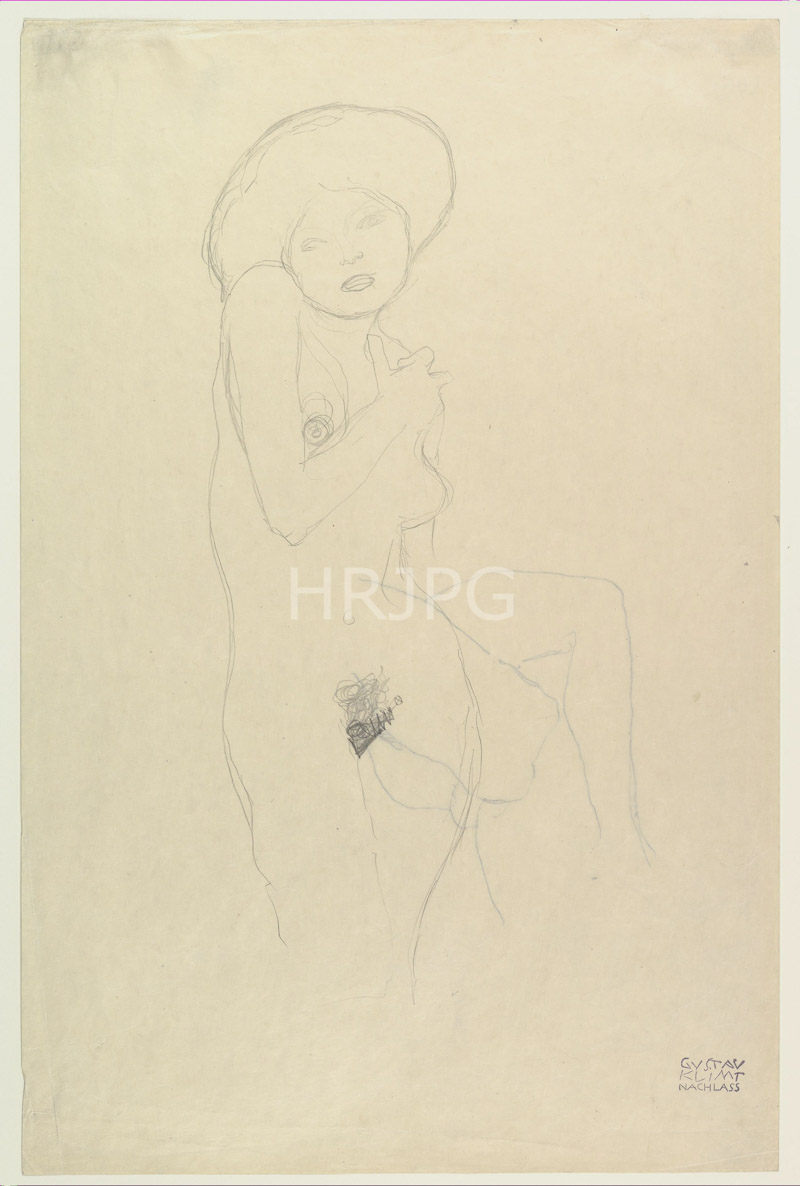
This refined pencil and graphite drawing, "Sitting Nude from the Back," was executed by Gustav Klimt around 1911 to 1912. It belongs to his mature period of graphic work, a time when he began to move away from the "heroic" and "monumental" anatomical styles inspired by Michelangelo and the High Renaissance. Instead, Klimt sought to capture a more "modern and intimate" view of the human body, characterized by soft curves, linear elegance, and a sense of quietude. This drawing was part of his daily studio practice, where he focused on the "essentialism" of the female form, stripping away the decorative ornamentation that dominated his contemporary oil paintings.
Technically, the work is a masterclass in the use of "contour and negative space." Klimt utilizes a continuous, flowing line to define the seated figure's back and hips, creating a sense of volume and weight through the sheer grace of the stroke. The "back view" is a deliberate compositional choice that shifts the focus from the subject's identity to the "geometry of the body." There is a remarkable sense of "anatomical simplicity" here; the artist omits unnecessary muscle definition in favor of a smooth, rhythmic surface. The shading is minimal, used only to suggest the delicate dip of the spine and the soft roundness of the shoulders. The placement of the figure on the page is strategic, utilizing the white space of the paper to enhance the sense of the model's "internal focus." This approach emphasizes a state of "quietude," where the body is seen as a vessel for a peaceful, unobserved moment. The line work is both delicate and firm, reflecting Klimt's unparalleled mastery of the pencil as a tool for both description and emotional expression.
From a historical perspective, this study marks Klimt's transition into his final "International Style." During these years, he was increasingly influenced by the "expressive honesty" of younger artists like Egon Schiele, leading him to abandon the idealized academic nude in favor of a more realistic and vulnerable portrayal of women. This period in Vienna was marked by a shift toward Expressionism, and Klimt's drawings from this time act as a crucial bridge between the decorative Art Nouveau movement and the raw psychological intensity that would soon dominate European modernism.
Art criticism has frequently praised these late studies for their "spiritual calm." Critics such as Christian Nebehay have argued that Klimt's drawings from 1911-1912 show him at his most "sincere," revealing a deep empathy for his models. "Sitting Nude from the Back" is often cited as an example of his ability to convey "personality through posture." The work is celebrated today for its "minimalist beauty" and its profound influence on modern figurative art. It proves that Klimt's genius was not dependent on gold leaf or complex allegories, but was rooted in his ability to see the extraordinary grace in the simplest human form. It remains a cornerstone for understanding the evolution of the female subject in the early 20th century.