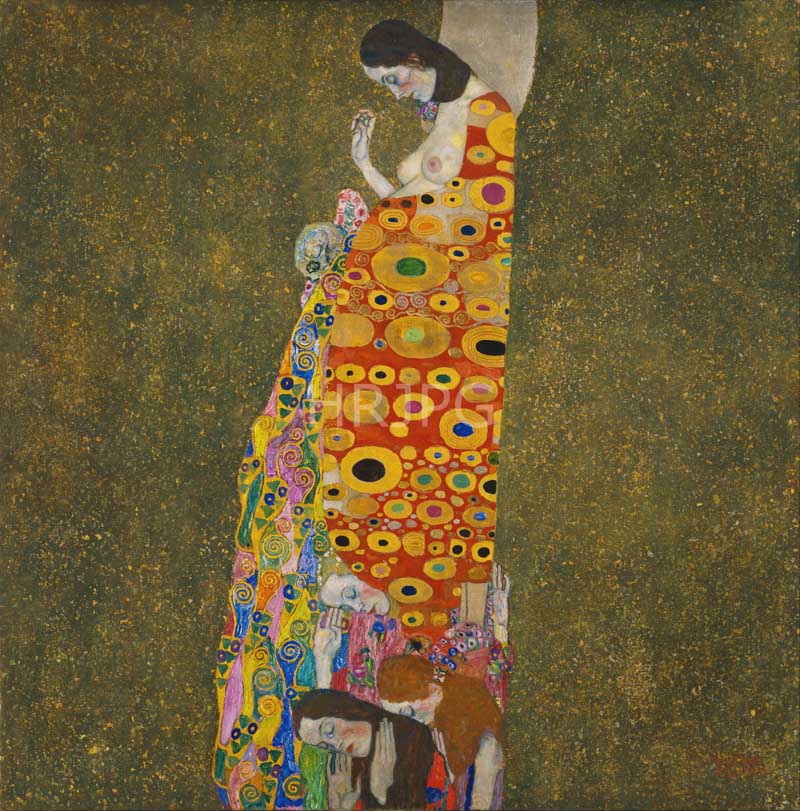
The iconic oil painting "Hope II" (originally titled "Vision") was created by Gustav Klimt between 1907 and 1908. This work is a centerpiece of his "Golden Phase" and serves as a direct follow-up to his controversial 1903 painting "Hope I." While the earlier version was scandalous for its "unvarnished" depiction of a pregnant nude, "Hope II" is more stylized and symbolic, utilizing a dense mosaic of patterns to frame the central subject. This painting is a profound meditation on the themes of birth, death, and the persistence of human hope, set against a background of Byzantine-inspired splendor. It represents Klimt at the height of his powers as a decorative Symbolist.
Technically, the composition is characterized by its "monumental verticality" and the use of gold and vibrant colors. The pregnant woman is positioned centrally, her head bowed in a state of quiet contemplation or prayer. She is enveloped in a voluminous, tapestry-like gown adorned with complex geometric and floral patterns—circles, squares, and stylized eyes that seem to watch the viewer. Klimt utilizes a "flattened" perspective, inspired by the mosaics of Ravenna and Japanese prints, which pushes the figure to the very front of the picture plane. A striking technical detail is the inclusion of a human skull tucked into the decorative folds of the woman's dress near her belly, serving as a "memento mori" (reminder of death). Below her, three mourning women bow their heads, their forms almost merging with the patterns of her gown. The contrast between the brilliant gold background and the dark, intricate motifs creates a visual vibration that heightens the painting's spiritual and mysterious aura.
Historically, "Hope II" reflects the intellectual tensions of early 20th-century Vienna. The work explores the duality of existence—the emergence of new life in the shadow of mortality. Klimt’s fascination with the "sacred nature of pregnancy" was a recurring theme, often viewed as a radical statement in a society that preferred to keep such domestic and biological realities hidden. The painting was acquired by the prominent patrons Otto and Eugenia Primavesi, illustrating the close link between Klimt and the industrialist families who supported the Viennese avant-garde.
Art criticism has long identified "Hope II" as one of the most successful syntheses of "eroticism and spirituality" in modern art. Critics such as Frank Whitford have noted that the woman is transformed into a "secular icon," her pregnancy treated with the same reverence usually reserved for religious figures. The painting is praised for its "psychological gravity," as it refuses to offer an easy or sentimental view of motherhood, instead acknowledging the profound and often frightening cycle of life. Modern scholars often point to the "hidden skull" as a masterpiece of Symbolist subtlety. Today, it is one of the most celebrated works in the Museum of Modern Art (MoMA) in New York, standing as a landmark of the Art Nouveau movement and a testament to Klimt's enduring relevance in the exploration of universal human experiences.