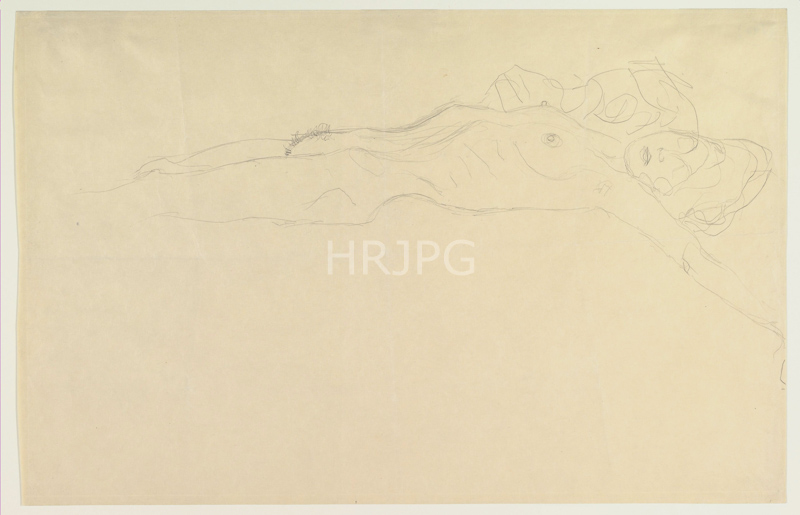
This exquisite pencil and chalk study, "Reclining Nude with Outstretched Left Arm," was produced by Gustav Klimt between 1904 and 1905. It was created during the most prolific years of his "Golden Phase," a time when he was meticulously planning the intricate compositions of works like "Water Snakes" and the "Beethoven Frieze." Klimt’s draftsmanship during this period reached a peak of technical refinement, where he could suggest the complex weight and emotional state of a body with a minimum of lines. This drawing is a classic example of his studio practice, where he allowed models to move freely, capturing spontaneous gestures that broke away from traditional academic poses.
Technically, the work is a masterclass in "rhythmic gesture." The composition is defined by the bold, horizontal stretch of the figure, with the left arm reaching outward, creating a dynamic diagonal that cuts across the paper. Klimt uses a fine, continuous pencil line to trace the contours of the body, emphasizing the softness of the skin and the anatomical tension in the reaching limb. There is almost no cross-hatching or heavy shading; instead, the artist relies on the "fluidity" of the line to suggest volume. The model's head is tilted back, and her hands are positioned behind her head, a pose that conveys a sense of total relaxation and unselfconscious sensuality. The use of white space is critical here, as it serves as a light-filled vacuum that emphasizes the "floating" quality of the figure. This approach illustrates Klimt's search for a "raw and expressive potential" in the nude, focusing on the internal feeling of the pose rather than just its outward appearance.
From a historical perspective, this drawing reflects the "liberation of the body" that was central to the Vienna Secession's mission. Klimt was interested in depicting women as active, sentient beings rather than passive objects of the male gaze. This specific study shows how he explored the "fluidity" of form that would later be fully realized in his underwater allegories. These works were often considered provocative in conservative Viennese society, as they prioritized the "erotic truth" of the human form over idealized, classical beauty.
Art criticism, particularly the work of Alessandra Comini, has identified these mid-period drawings as the "raw nerve" of Klimt's creative process. Critics have noted the "melodic" nature of his lines, describing them as "visual music." "Reclining Nude with Outstretched Left Arm" is praised for its "effortless elegance," proving that Klimt's greatness lay in his ability to see the monumental within a fleeting, everyday gesture. Today, it is regarded as a foundational work in modern graphic art, demonstrating the shift from 19th-century realism to the more subjective and expressive draftsmanship of the 20th century. It remains a vital document for understanding the anatomical foundations of his most famous decorative paintings.