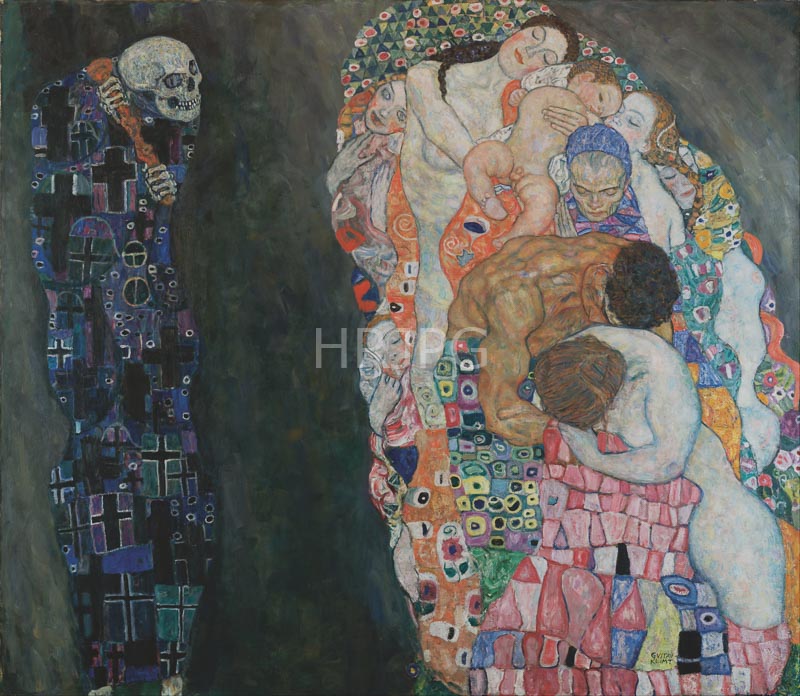
The monumental allegorical painting "Death and Life" was created by Gustav Klimt between 1910 and 1915. This work is considered one of his most significant late masterpieces, representing a bridge between his decorative "Golden Phase" and his more expressive final style. In 1911, the painting won the first prize at the International Art Exhibition in Rome, yet Klimt, ever the perfectionist, decided to revise the work in 1915. He famously changed the background from a gold-toned surface to a somber, metallic blue-grey and added more intricate patterns to the figures, reflecting the growing darkness of the war years and his deepening preoccupation with the cycle of human existence.
Technically, the composition is a profound study in "dualism and contrast." On the left, a solitary, skeletal figure of Death stands, draped in a dark robe adorned with cross-like symbols. Death is depicted not as a terrifying monster, but as a watchful, almost patient observer, leaning forward with a small club. On the right, a dense, swirling "huddle" of human figures—representing all stages of life from infancy to old age—is depicted in a state of dreamlike suspension. Klimt utilizes a vibrant color palette for the living figures, contrasting their warm skin tones and the riotous patterns of their textiles against the cold, dark void that surrounds them. The composition is purposefully asymmetrical, creating a visual tension that suggests the precariousness of life in the face of the eternal. The "mosaic-like" application of color in the blankets and robes unifies the diverse group of humans into a single, collective entity, illustrating the universal nature of the human experience.
Historically, "Death and Life" is a quintessential product of the "Fin-de-Siècle" Viennese intellectual climate, which was deeply influenced by the burgeoning field of psychoanalysis and the philosophical writings of Schopenhauer and Nietzsche. The painting explores the "Trieb" (drive) of life—eros—against the inevitability of thanatos. It captures the spirit of a city that was simultaneously obsessed with beauty and decay. The 1915 revisions are particularly telling, as they show Klimt moving away from the "materialistic" splendor of gold toward a more atmospheric and psychologically resonant aesthetic.
Art historians, including Frank Whitford, have praised "Death and Life" for its "epic stillness." Critics note that the painting does not depict a struggle, but a coexistence; Death and Life are part of the same decorative and cosmic pattern. The work is often compared to the "Danse Macabre" tradition, but reimagined through the lens of modern Symbolism. Today, it remains a centerpiece of the Leopold Museum in Vienna, celebrated for its ability to convey profound philosophical truths through a sophisticated synthesis of color, form, and ornamentation. It is a powerful reminder of Klimt's unique ability to transform the anxieties of his age into a timeless vision of human resilience.