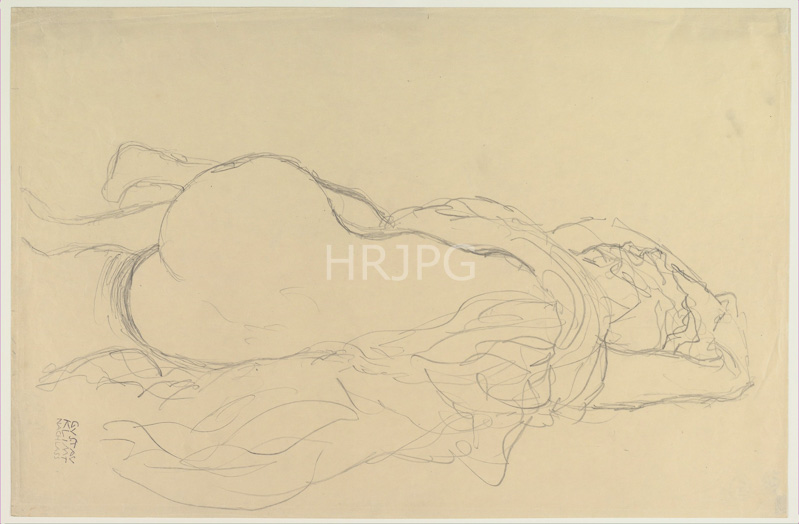
The evocative graphite drawing "Reclining Nude with Drapery Back View" was produced by the Austrian master Gustav Klimt approximately between 1912 and 1913. During this mature period, Klimt moved away from the complex, gold-laden allegories of his middle years to focus on the raw, intrinsic beauty of the human form through the medium of drawing. His studio served as a sanctuary where he could observe his models in unposed, natural states, allowing him to capture the "truth" of the female body beyond the constraints of social decorum or academic rigidness. This work is a testament to the "linear economy" that defined his late graphic style.
Technically, the composition is centered on the rhythmic curves of the female back, a subject Klimt approached with both clinical precision and poetic sensitivity. He utilizes a singular, confident contour line to define the silhouette, varying the pressure of the graphite to suggest the soft volume of flesh and the structural strength of the spine. The "drapery" mentioned in the title is not a central subject but a textural counterpoint; the jagged, nervous lines of the fabric contrast sharply with the fluid, sweeping arcs of the body. This juxtaposition emphasizes the organic nature of the figure. By choosing a back view, Klimt creates a sense of "anonymity and introspection," turning the body into a landscape of form and shadow. The use of negative space is masterful, as the white of the paper acts as a luminous field that pushes the figure toward the viewer, highlighting the artist's ability to convey monumental presence through minimal graphic means.
Historically, this work reflects the influence of the younger Viennese Expressionists, such as Egon Schiele, whose aggressive draftsmanship encouraged Klimt to embrace a more "energetic and modern" line. This was a period of intense cultural transition in Vienna, where the decorative grace of Art Nouveau was beginning to give way to a more psychologically charged and existential form of art. These private drawings were essential to Klimt's daily practice, serving as a laboratory for the anatomical simplifications that would appear in his late oil paintings like "The Bride."
Art criticism of the late 20th century has frequently highlighted the "modernity" of Klimt's back-view studies. Critics like Jane Kallir have argued that these works show Klimt at his most "authentic," free from the ornamental "armor" of his public commissions. The drawing is praised for its "melodic" quality, where the line itself becomes a form of artistic breath, capturing a fleeting moment of private intimacy. It remains a vital reference for the study of modern figurative art, demonstrating how the traditional nude could be transformed into a vehicle for psychological and aesthetic exploration in the early 20th century.