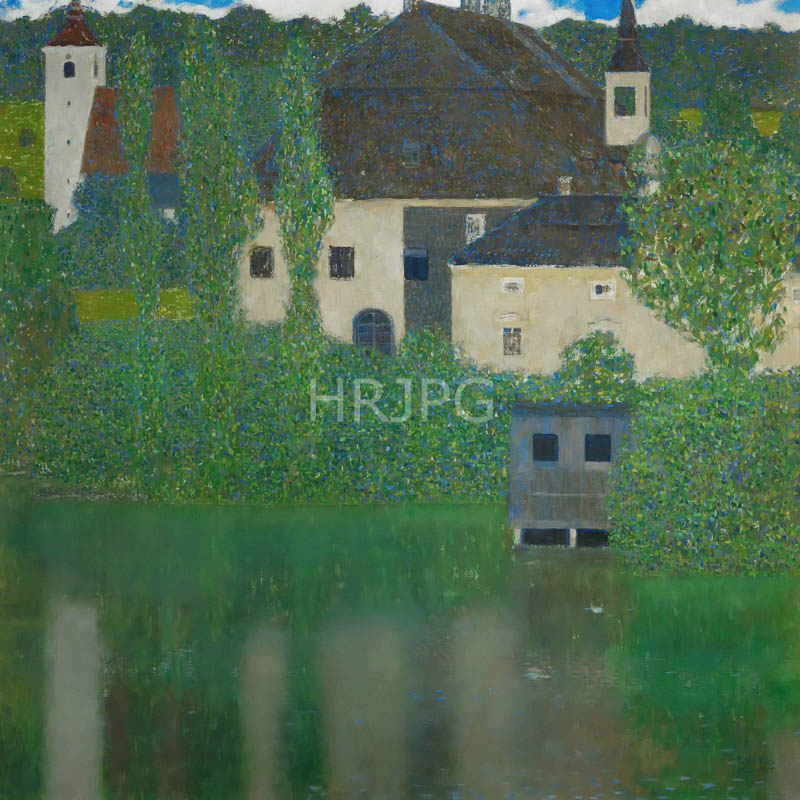
The enchanting oil painting "Water Castle" (also known as "Schloss Kammer on the Attersee I") was created by Gustav Klimt around 1908. This work belongs to his highly acclaimed series of Attersee landscapes, which he painted during his summer residences at the lake. This specific canvas was produced at the height of his "Golden Phase," a period characterized by a unique synthesis of Art Nouveau decoration and Symbolist depth. In "Water Castle," Klimt turns his attention to the historic architecture of the region, treating the stone structure of the castle with the same jewel-like intensity as he did the natural foliage and the shimmering water.
Technically, the composition is a masterpiece of "flattened" decorative space. Klimt utilizes a high horizon line and a compressed perspective to bring the castle, the surrounding greenery, and the water's surface into a single, unified plane. The architecture of the castle is integrated into a dense mosaic of brushstrokes, where the distinctions between natural and man-made forms begin to dissolve. The color palette is a vibrant symphony of emerald greens, turquoise blues, and warm earth tones, applied with short, rhythmic dabs that create a shimmering, textured surface. The reflections in the water are not rendered realistically but are instead treated as an extension of the decorative pattern of the shore. This approach was heavily inspired by Japanese prints and the mosaic-tiled walls of Byzantine architecture, which Klimt had seen during his travels to Ravenna. By prioritizing pattern and color over traditional depth, Klimt creates a timeless, almost mystical atmosphere that transcends mere topography.
Historically, the "Water Castle" series was part of a larger cultural project to celebrate the beauty of the Austrian countryside through a modern, Secessionist lens. These paintings were highly sought after by the Viennese upper class, providing them with a refined, artistic view of their own summer retreats. This work demonstrates Klimt's search for the "Gesamtkunstwerk" (total work of art) even within the genre of landscape painting, where every element of the scene contributes to a harmonious and decorative whole.
Art historians have consistently praised "Water Castle" for its innovative approach to landscape architecture. Critics such as Frank Whitford have noted that Klimt’s buildings are treated like "precious objects," and his landscapes are "tapestries of light." The painting is celebrated for its ability to convey a sense of "tranquil monumentality," a quality that is characteristic of his mature landscape style. Modern criticism highlights the work as a bridge between late 19th-century Symbolism and the early 20th-century move toward total abstraction. It remains a cornerstone of the Belvedere collection in Vienna, standing as a testament to Klimt's ability to transform the world into a shimmering, decorative paradise.