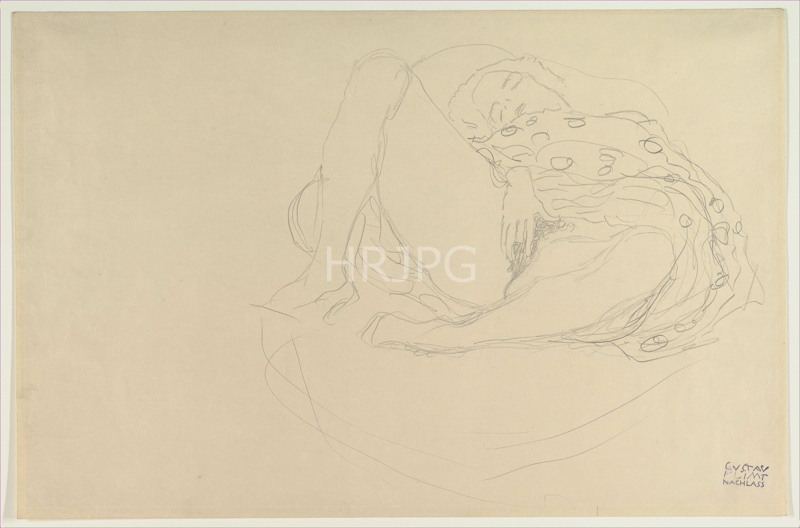
This refined graphite study, titled "Reclining Nude with Drapery," was produced by Gustav Klimt around 1912 to 1913. It is a quintessential example of the artist’s late drawings, where he explored the delicate interplay between the human form and the textures of the domestic environment. During this late phase, Klimt was increasingly obsessed with capturing the "natural grace" of his models in moments of repose, a departure from the highly posed and allegorical figures of his earlier career. This work is part of a larger series of erotic and intimate drawings that were highly influential in the development of modern graphic expression in Vienna.
Technically, the drawing is a masterclass in the use of the "Secessionist line" to define both flesh and fabric. Klimt utilizes fluid, continuous contours to trace the body of the reclining woman, while using a more rhythmic, jagged line to define the folds of the drapery. The contrast between the smooth lines of the torso and the complex, patterned lines of the fabric creates a visual tension that keeps the eye moving across the paper. There is a remarkable sense of "self-assuredness" in the pose; the woman appears relaxed and unconcerned with the viewer's gaze, which adds to the work's sense of authenticity and modern intimacy. The artist uses almost no shading, relying instead on the varying thickness of the pencil line to suggest volume and the tactile quality of different surfaces. The composition is carefully balanced, with the negative space of the paper acting as a silent environment that focuses all attention on the central figure and her immediate surroundings.
Historically, this study reflects the rise of a new, more realistic feminine ideal in the early 20th century. Klimt’s models were often the working-class women of Vienna, and his drawings capture their physical presence without the "idealizing" filters of academic art. This period saw Klimt moving away from the "Golden Phase" to a more "painterly" and "linear" aesthetic, influenced by his travels and his exposure to the works of Van Gogh and the French Expressionists. These drawings were central to his daily practice, serving as a primary means of artistic exploration and personal expression.
Art criticism of the late 20th century has frequently focused on the "modernity" of Klimt’s late drawings. Critics such as Jane Kallir have argued that works like "Reclining Nude with Drapery" represent the peak of his graphic achievement, where the line becomes a pure expression of life and vitality. The drawing is praised for its "sophisticated simplicity," proving that Klimt could achieve a sense of monumental beauty through the most minimal means. It is regarded today as a vital document of the Viennese Secession era, illustrating the shift toward a more intimate, psychological, and unvarnished view of the human subject.