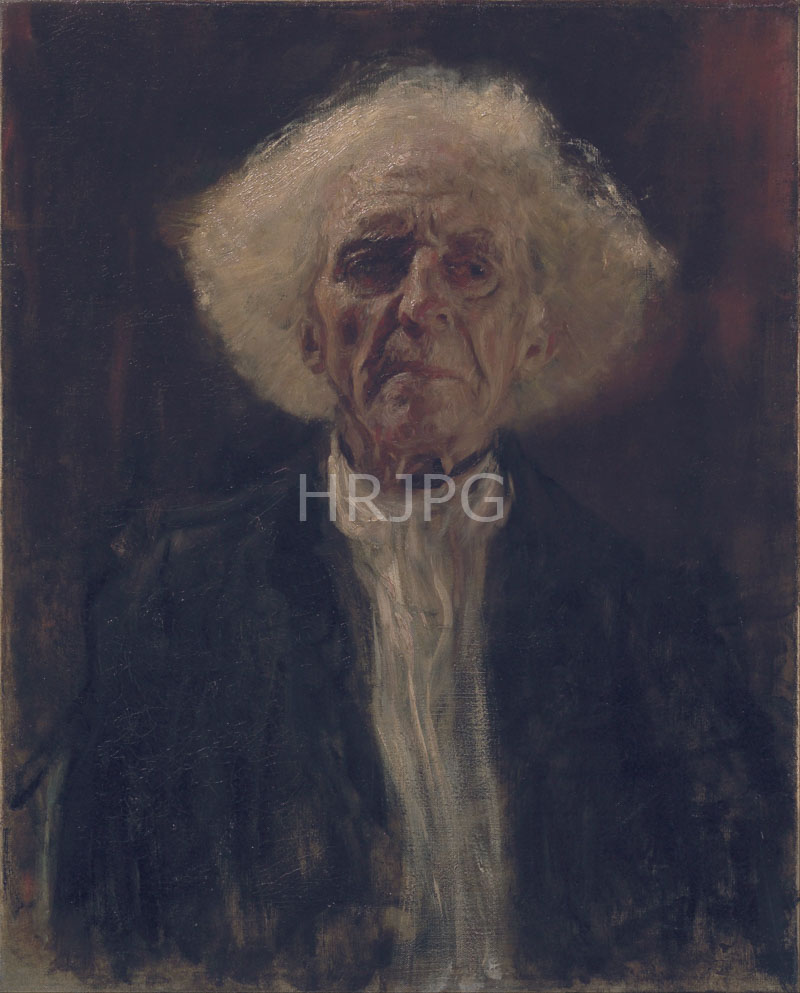
The haunting oil painting "The Blind Man" was created by Gustav Klimt around 1896, a critical transitional year just before the founding of the Vienna Secession. This work represents one of the earliest and most profound examples of Klimt’s departure from the rigid, academic naturalism of his youth toward the enigmatic world of Symbolism. At this stage, Klimt was beginning to grapple with the deeper, invisible forces of the human psyche—themes that would soon define the intellectual landscape of "Fin-de-Siècle" Vienna. The subject of blindness serves as a potent metaphor for the artist’s shift from external observation to internal perception.
Technically, the work is defined by its somber, monochromatic color palette and a soft, almost ethereal focus. Klimt utilizes a range of deep grays, browns, and muted blues to create a twilight atmosphere that envelops the figure. The composition is simple yet powerful, with the blind man’s head positioned centrally, his eyes closed or clouded, suggesting a complete withdrawal from the material world. The lighting is diffused and directional, casting subtle shadows that emphasize the vulnerability and introspection of the subject. Unlike the sharp, clear lines of his earlier historical murals, "The Blind Man" features blurred edges and a painterly texture that suggests a dreamlike or visionary state. This "sfumato" technique allows the figure to emerge from and recede into the darkness, emphasizing the psychological weight of his condition. The textures of the clothing and skin are rendered with a quiet sensitivity that heightens the sense of tactile intimacy.
Historically, this work was produced during a period of intense intellectual fermentation in Vienna, coinciding with the early writings of Sigmund Freud. The move toward Symbolism was a reaction against the materialism of the Ringstrasse era, as artists sought to represent the "inner truths" of human existence. "The Blind Man" reflects this broader cultural trend, where physical disability is reinterpreted as a form of spiritual insight. It marks the moment when Klimt began to see the canvas not as a window to the world, but as a mirror of the soul, setting the stage for his later allegorical masterpieces like "Philosophy" and "Medicine."
Art historians often cite "The Blind Man" as a key work in the evolution of Viennese modernism. Critics have noted that the painting possesses a "quiet monumentality" that anticipates the existential weight of 20th-century art. Contemporary reviews praised the work for its "haunting sincerity," noting that Klimt had successfully captured a state of profound human vulnerability. Modern criticism, such as that by Christian Nebehay, highlights the painting as a crucial document of Klimt’s break with the "Künstlerhaus" tradition. It remains a moving and somber masterpiece, serving as a reminder that Klimt’s brilliance was rooted as much in psychological depth as it was in decorative splendor.