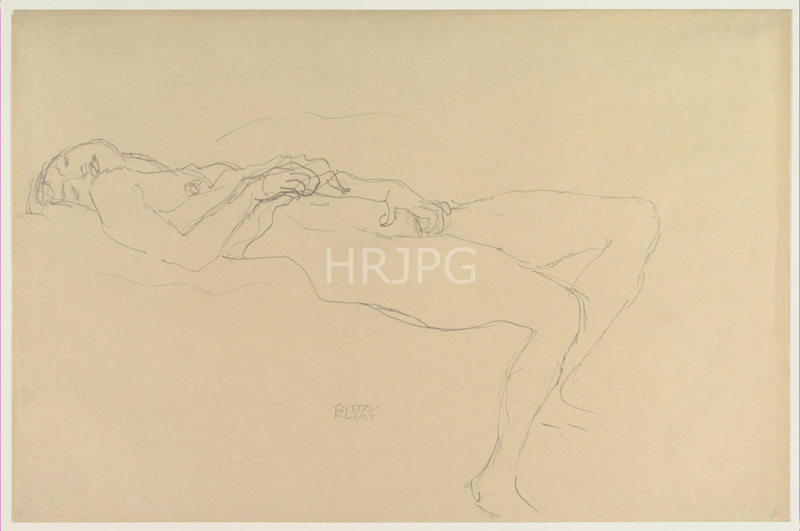
This delicate and evocative pencil drawing, titled "Reclining Nude," was executed by Gustav Klimt approximately between 1912 and 1913. It was produced during his prolific late period, a time when the artist retreated from the monumental oil paintings that had defined his earlier career to focus on the raw, intimate potential of graphic art. Klimt’s studio was known to be a sanctuary of spontaneous movement, where models would lounge and move freely while the artist captured their forms in rapid succession. This drawing is a testament to his mastery of the "Secessionist line"—a style that emphasized fluid, unbroken contours and a profound sensitivity to the female form.
Technically, the work is characterized by its "linear economy" and the confident use of the pencil to suggest volume without heavy shading. Klimt utilizes long, undulating strokes to trace the curves of the reclining figure, emphasizing the weight and relaxation of the body. The composition is daringly horizontal, utilizing the white space of the paper to enhance the sense of intimacy and isolation. There is a specific focus on the rhythmic flow of the limbs and the sensuality of the pose, which is captured with a sense of erotic honesty that was characteristic of the Viennese avant-garde. The artist omits detailed facial features or background elements, choosing instead to let the "contour" itself convey the psychological and physical presence of the model. This approach reflects the influence of the younger Expressionists, such as Egon Schiele, whose jagged lines encouraged Klimt to find a more nervous and energetic quality in his own late drawings.
Historically, these late erotic drawings reflect the changing social and moral climate of pre-war Vienna. While Klimt’s public works were often veiled in allegory, his drawings were far more direct in their exploration of female sexuality. These works were mostly private and were only shared with close friends and fellow artists, serving as a laboratory for his evolving aesthetic. This period saw Klimt moving toward a more "human" and less "iconic" representation of women, reflecting his personal relationships and the broader cultural shift toward psychological realism in Austria.
Art criticism has consistently highlighted the importance of Klimt’s late drawings as some of the most innovative graphic works of the 20th century. Critics like Alessandra Comini have argued that these studies are the "true heart" of Klimt’s late style, revealing a level of intimacy and vulnerability that is often hidden beneath the gold of his famous canvases. The drawing is praised for its "melodic" quality, where the line becomes a form of artistic breath. It remains a vital reference point for understanding the development of modern figurative art and the shift from Art Nouveau's decorative grace to the raw emotionality of Expressionism.