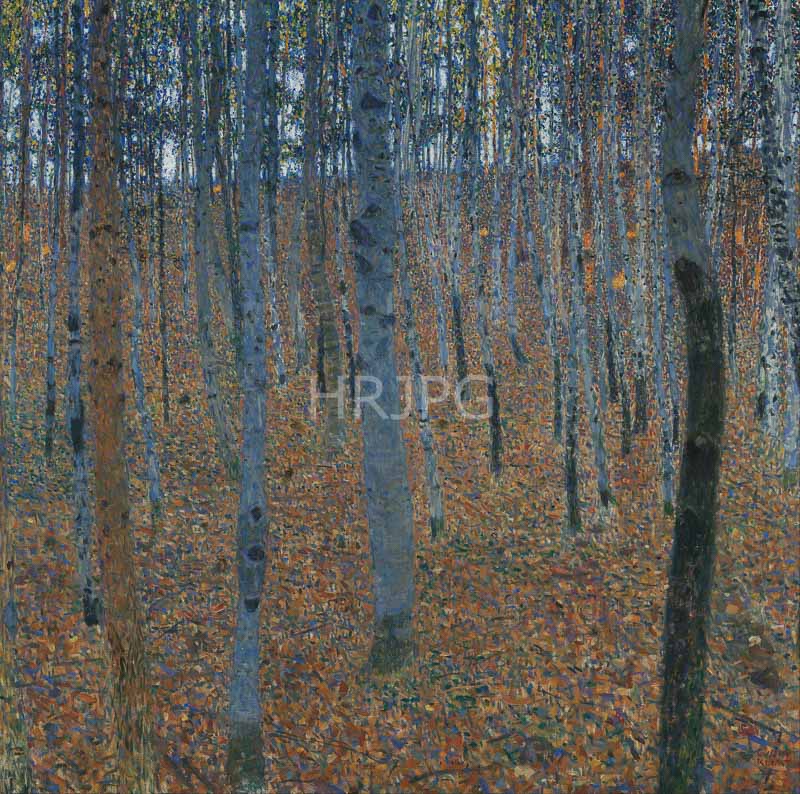
The landscape masterpiece "Beech Grove I" was painted by the Austrian Secessionist leader Gustav Klimt in 1902. This work is a premier example of Klimt’s "forest interior" paintings, which he produced during his summer retreats to the Attersee region. During this period, Klimt was increasingly moving away from the scandalous public controversies of his "Faculty Paintings" and finding solace in the rhythmic, silent patterns of the natural world. This painting serves as a bridge between his earlier Impressionistic experiments and the highly structured, decorative mosaic style that would define his "Golden Phase."
Technically, the composition is radical for its time due to its lack of a traditional focal point or a discernible horizon line. Klimt fills the entire square canvas with the vertical trunks of beech trees, creating an immersive, claustrophobic yet meditative space. The viewer is placed directly within the grove, with no sky visible, forcing the eye to wander through the rhythmic repetition of vertical lines and the dense, dappled carpet of autumnal leaves on the forest floor. The color palette is a rich symphony of ochre, russet, and gold, applied with short, mosaic-like brushstrokes that emphasize surface texture over depth. By flattening the perspective, Klimt transforms a natural scene into a decorative pattern, where the play of light on the trunks becomes a series of abstract patches rather than a realistic rendering of volume.
Historically, "Beech Grove I" reflects the influence of Belgian Symbolism and the "Japonisme" movement on the Viennese avant-garde. The choice of the square format was intentional, as Klimt believed it represented a more harmonious and non-hierarchical view of nature compared to the traditional rectangular landscape. This work was produced during a time of intense creative output for the Secession, following the success of the Beethoven Frieze, and demonstrates Klimt's ability to apply the principles of "total art" even to the simplest natural observations.
Art criticism has long celebrated "Beech Grove I" for its spiritual and psychological resonance. Critics such as Frank Whitford have noted that Klimt’s forests are not mere depictions of trees but "interiors of the soul," where the rhythmic repetition suggests a sense of cosmic order and eternity. The painting was praised at the time for its "tapestry-like" quality, a term that contemporary scholars like Jane Kallir continue to use to describe the synthesis of nature and ornament. It is now considered a foundational work in the evolution of modern landscape painting, prefiguring the developments of pure abstraction by focusing on the rhythmic and decorative essence of the natural environment.