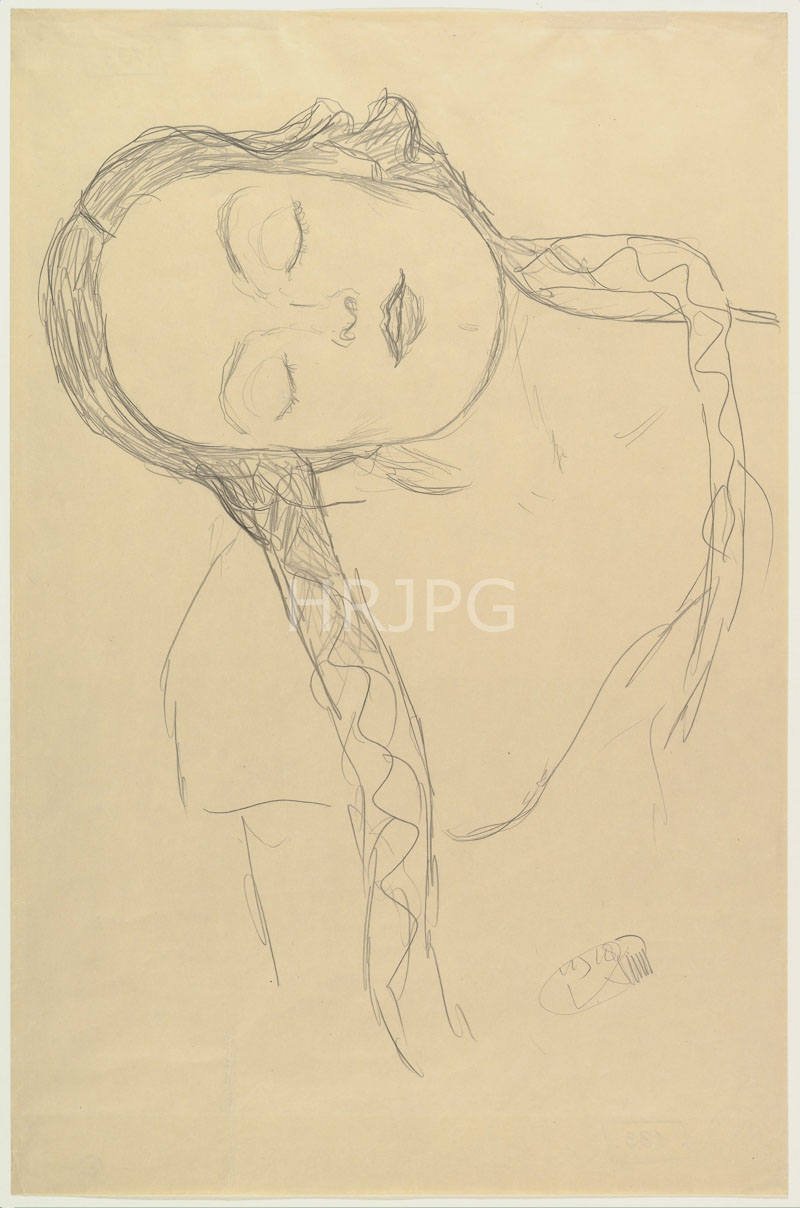
This moving pencil drawing, "Half figure of a Young Woman," was executed by Gustav Klimt in 1918, the year of his death. As one of his final graphic works, it encapsulates the culmination of his life's work in portraiture—a transition from the ornate and heavily stylized to the simple, expressive, and profoundly human. Throughout his career, Klimt remained fascinated by the female form, but in his final years, he sought to strip away the "decorative armor" of his subjects to reveal a more vulnerable and quiet personality. This drawing is a poignant example of that search for the essential spirit of his models.
Technically, the drawing is characterized by its "linear economy." Klimt uses minimal graphic means to convey a complex range of emotions. The lines are remarkably fluid and confident, tracing the contours of the young woman's face and shoulders with a sense of effortless grace. There is almost no shading or hatching; instead, the artist relies entirely on the weight and direction of the line to suggest volume and presence. The composition focuses on the upper half of the figure, with the woman's head tilted slightly, her gaze cast downward or toward the side, suggesting a state of quietude and introspection. This "linear portraiture" is highly modern, anticipating the simplified forms of mid-20th-century figurative art. The way the lines of the hair and clothing dissolve toward the edges of the paper emphasizes the ephemeral nature of the subject, creating a sense of lightness and elegance that is characteristic of his late mature drawings.
From a historical perspective, 1918 was a year of profound tragedy and change, marked by the end of the Great War and the devastating Spanish flu pandemic, which ultimately took Klimt's life. This drawing reflects the somber, reflective mood of that time. It shows a move away from the "femme fatale" archetype that dominated his earlier work toward a more realistic and empathetic view of women. This shift in perspective was likely influenced by his deepening personal relationships and the changing social roles of women in post-war Vienna.
Art criticism has frequently highlighted the "psychological resonance" of Klimt's late drawings. Critics like Christian Nebehay have argued that these works show Klimt at his most "honest," free from the demands of wealthy patrons. Praised for its "minimalist beauty," this drawing is seen as a precursor to the work of Egon Schiele and the broader Expressionist movement, demonstrating how a simple line could convey the weight of a person's inner life. Today, "Half figure of a Young Woman" is regarded as a masterclass in modern draftsmanship, proving that even in his final days, Klimt remained a pioneer in the artistic exploration of the human soul. It is a quiet but powerful conclusion to the career of one of the most influential artists of the modern era.