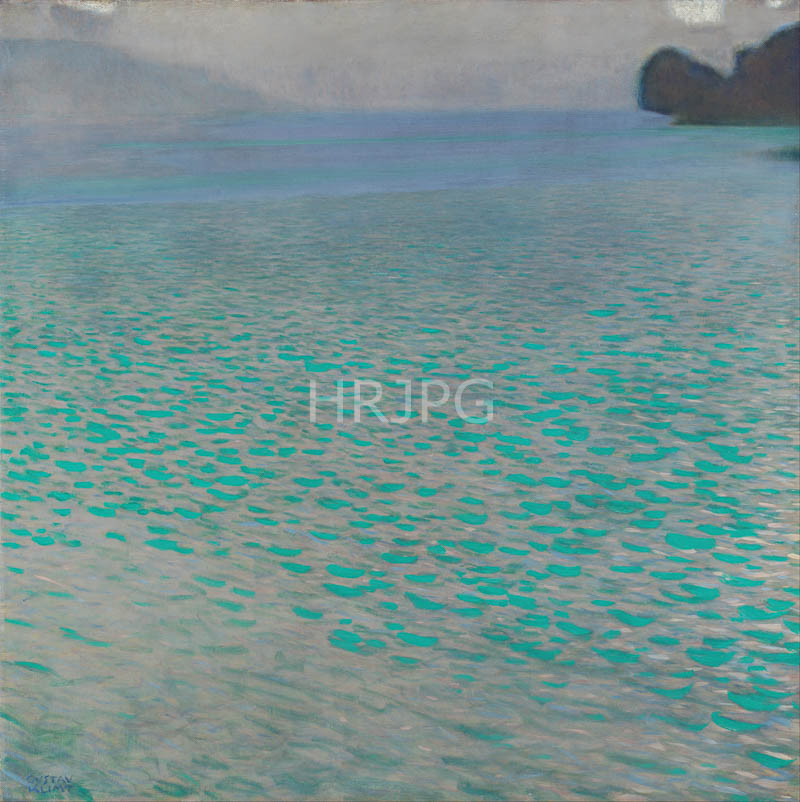
The oil painting "Attersee" (also known as "On Lake Attersee") was created by Gustav Klimt in 1900. This work marks a pivotal moment in the artist's career, as it is one of his first radical departures into a nearly abstract approach to landscape painting. Painted during his initial summer stays at the lake with the Flöge family, this canvas captures the shimmering surface of the water with a level of focused observation that feels almost scientific, yet it remains deeply rooted in the decorative traditions of the Vienna Secession. It serves as a foundational work for his subsequent two decades of summer nature studies.
Technically, "Attersee" is famous for its "flattened" spatial organization and its high horizon line, which is pushed so far to the top of the canvas that the water occupies almost the entire visual field. This composition was heavily influenced by the Japanese Ukiyo-e aesthetic, particularly the works of Hiroshige, which Klimt collected. The surface of the lake is rendered with thousands of tiny, flickering brushstrokes in varying shades of turquoise, emerald, and deep blue. These marks do not follow traditional rules of perspective; instead, they create a uniform "pattern" that emphasizes the two-dimensional surface of the painting. The play of light on the waves is captured through the juxtaposition of these colors, creating a sense of depth through chromatic vibration rather than linear geometry. The lack of a clear focal point or human presence makes the work feel eternal and meditative, as if the viewer is staring into infinity.
Historically, the year 1900 was a time of significant upheaval for Klimt, as he was embroiled in the controversy surrounding his "Faculty Paintings" for the University of Vienna. His retreat to Lake Attersee provided a necessary mental and artistic escape. In this landscape, he found a sense of "tranquility" that he could not achieve in his public commissions. This painting represents the birth of his "square format" landscapes, which he believed provided a more balanced and harmonious view of nature, free from the hierarchies of traditional landscape painting.
Art historians and critics have long marveled at the "modernity" of this work. At the time of its exhibition, it was seen as a radical step toward abstraction, with some critics even comparing its visual effect to that of a tapestry or a precious gemstone. The critic Frank Whitford noted that Klimt’s water landscapes were "purely optical experiences," prefiguring the later developments of Color Field painting. "Attersee" is celebrated today as a masterpiece of late-century Symbolism, capturing a sense of nature as a sacred, decorative space. It remains one of the most beloved works in the Leopold Museum collection, standing as a testament to Klimt's ability to see the extraordinary within the seemingly simple surface of the natural world.