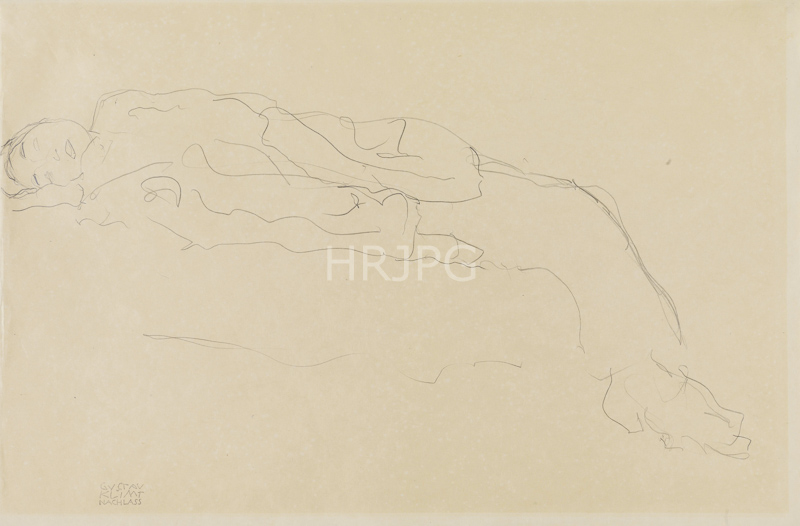
This exquisite graphite and chalk sketch, titled "Reclining Woman," was produced by Gustav Klimt around 1904. It was created during the height of the artist's "Golden Phase" and served as a crucial preparatory study for some of his most famous allegorical works, most notably "Water Snakes II." This period in Klimt's life was defined by his obsession with the fluid beauty of the female form and the exploration of eroticism within the framework of the Vienna Secession. The drawing is a testament to his ability to capture a sense of weightless sensuality through a combination of rigorous draftsmanship and poetic intuition.
Technically, the drawing is a study in "rhythmic outlines" and anatomical grace. Klimt uses long, sweeping strokes of the pencil to define the contours of the reclining body, creating a sense of movement that seems to flow across the page like water. The shading is extremely subtle, utilized only to suggest the softest transitions of light across the skin and to give the figure a delicate three-dimensional volume. The composition is daringly horizontal, emphasizing the languid, passive state of the model. The way the woman's limbs are intertwined and her face is partially obscured creates a sense of mystery and intimacy, as if the viewer is intruding upon a private, dreamlike space. The artist intentionally leaves the hands and feet less defined, focusing the viewer's eye on the undulating line of the torso and hips, which becomes the primary expressive element of the work.
Historically, this sketch reflects the cultural climate of "Fin-de-Siècle" Vienna, a city obsessed with the depths of the human psyche and the complexities of desire. Klimt’s studio was a place of constant experimentation, where models would move freely while the artist captured spontaneous gestures. This specific study shows how Klimt began to move away from the static, academic nude toward a more "fluid" representation of femininity that would later be fully realized in his underwater allegories. These works were often controversial, pushing the boundaries of what was acceptable in a society that was simultaneously repressed and fascinated by sexuality.
Art criticism has identified these "Water Snake" studies as some of the most innovative drawings of the early 20th century. Critics like Alessandra Comini have noted that Klimt’s drawings are often more revealing than his finished paintings, as they show the "raw nerve" of his artistic intent. "Reclining Woman" is praised for its "melodic" quality, where the line itself becomes a form of music. It is regarded as a pinnacle of the Secessionist aesthetic, embodying the ideal of beauty as something fleeting, mysterious, and profoundly sensual. Today, it remains a vital reference for the study of modern graphic art and the evolution of the female subject in Western art history.