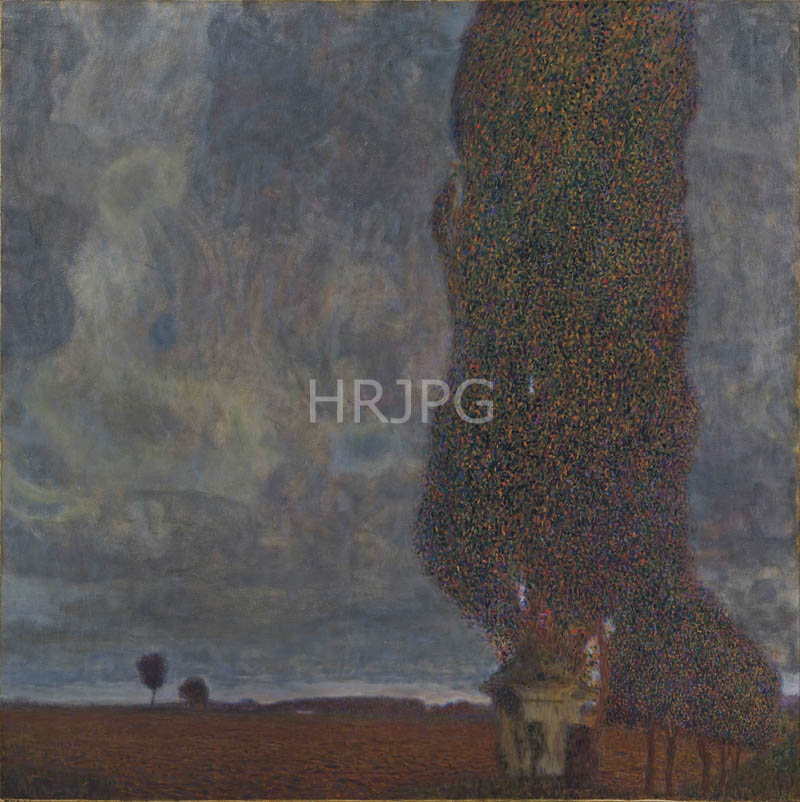
The landscape titled "The Big Poplar II" (also known as "The Coming Storm") was painted by Gustav Klimt in 1903. This work is a cornerstone of Klimt's landscape repertoire, created during a period when he spent his summers at Lake Attersee, seeking refuge from the high-pressure social environment of the Vienna Secession. This particular canvas is celebrated for its monumental scale and its intense atmospheric quality, capturing a moment of natural tension that borders on the metaphysical. It serves as a vital precursor to the more abstract and decorative nature studies that would define his later career.
Technically, the composition is anchored by the massive, centralized form of the poplar tree, which acts as a stable vertical axis against the chaotic energy of the sky. Klimt utilizes a sophisticated version of Pointillism—often referred to as his "mosaic" style—to render the foliage and the surrounding meadow. Each tiny dab of color contributes to a shimmering, textured surface that vibrates with life. The color palette is dominated by deep, moody greens and blues in the foliage, contrasted against the swirling, turquoise-tinted grays of the storm clouds. The composition is purposefully "flat," inspired by the Japanese Ukiyo-e prints that Klimt so admired, which forces the viewer to focus on the surface tension and the rhythmic interplay of patterns rather than traditional perspectival depth. The sheer density of the paint application creates a physical presence that makes the landscape feel like a living, breathing entity.
Historically, 1903 was a year of great professional success for Klimt, yet it was also a time of deep artistic introspection. This was the year of his "Great Klimt Exhibition" at the Secession, where he showcased the full breadth of his vision. "The Big Poplar II" represents his search for a synthesis between naturalistic observation and a highly stylized, symbolic form of nature. By focusing on a single, heroic tree, Klimt elevates the landscape from a mere depiction of scenery to a portrait of a living spirit, reflecting the Panpsychist views popular among the Viennese avant-garde of the time.
Critics have long praised this work for its emotional resonance and its innovative approach to landscape painting. Contemporary reviews noted the "eerie stillness" of the scene, describing it as a landscape of the soul rather than a topographic record. Modern scholars, such as Frank Whitford, point out that the tree serves as a metaphor for the artist himself—standing firm and solitary amidst a gathering storm of public controversy and shifting artistic tastes. The painting is now considered a masterpiece of European Symbolism, demonstrating how Klimt could transform a simple natural observation into a profound meditation on the power and mystery of the natural world.