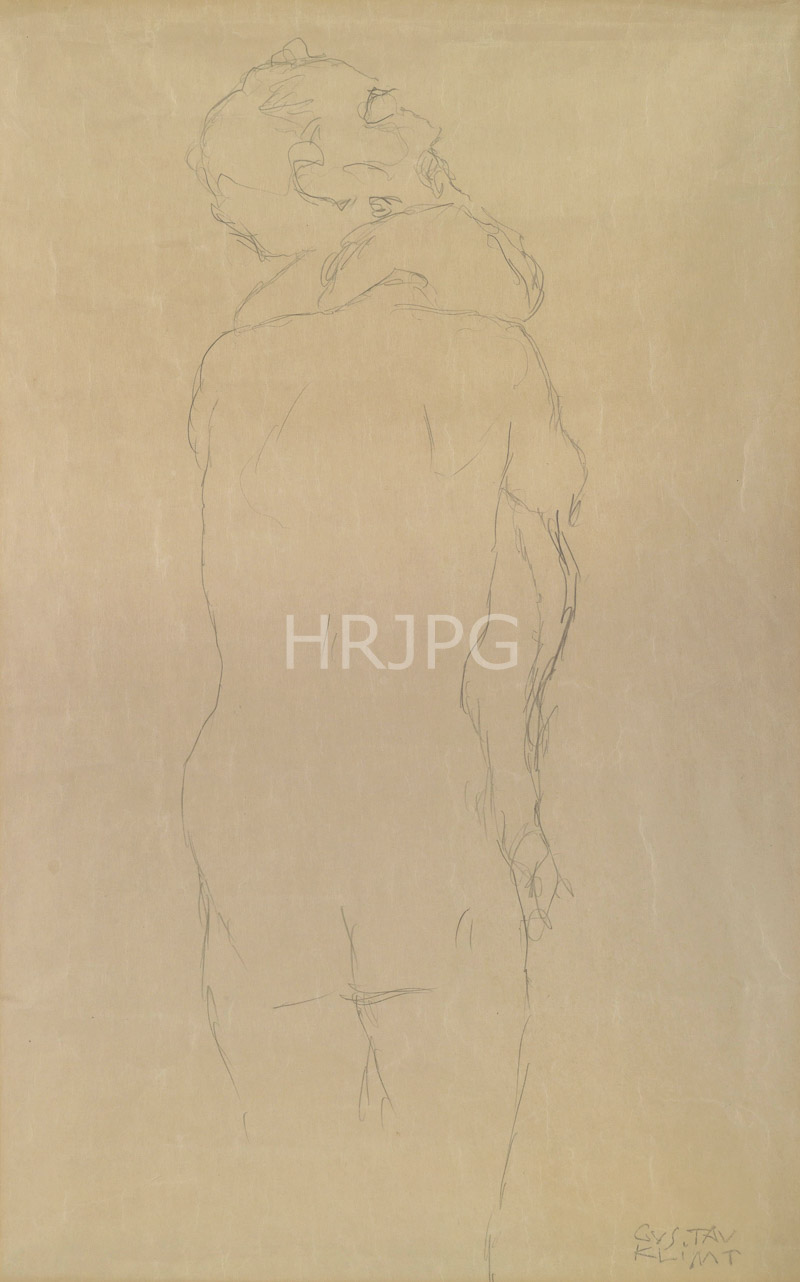
This profound pencil study was created by the Austrian master Gustav Klimt around 1917 to 1918, during the very final stage of his life and career. As a preparatory work for his large-scale oil painting of the same name, this drawing offers a rare glimpse into the artist's late-stage creative process, where he moved away from the intricate ornamentation of his middle years toward a more raw and spiritually focused representation of the human form. At this juncture, Klimt was deeply engaged with universal themes of creation, morality, and the shared destiny of mankind, a reflection of the somber atmosphere in Vienna during the waning years of World War I.
Technically, the study is a masterpiece of anatomical simplification and linear rhythm. Klimt employs elongated figures to emphasize a sense of spiritual elevation rather than mere physical presence. The lines are remarkably sensitive, varying in weight and pressure to suggest volume and shadow without the need for heavy cross-hatching. The composition is structured around the physical and symbolic intersection of the two subjects, where the fluid outlines of Adam and Eve seem to merge, suggesting a primordial unity. The artist omits unnecessary background detail to focus entirely on the expressive power of the bodies, utilizing the negative space of the paper to enhance the ethereal quality of the scene. This "essentialism" in his draftsmanship marks a significant evolution from his earlier, more rigid academic studies.
From a historical perspective, this work was produced during a period of immense personal and social transition. Klimt was witnessing the collapse of the Austro-Hungarian Empire and the rise of a more turbulent, modern world. His choice of the Adam and Eve motif was not merely religious but existential, exploring the origins of human suffering and love. This study demonstrates how Klimt began to internalize the influences of younger Expressionists like Egon Schiele, adopting a more nervous and emotionally charged line that prioritized psychological truth over aesthetic perfection.
Art criticism of the late 20th century has frequently revisited these final drawings, noting their profound influence on the development of modern linear portraiture. Critics like Jane Kallir have argued that Klimt's late studies represent a "breaking of the gilded cage," where the artist finally allowed the human essence to breathe without the suffocating weight of gold leaf. The "Adam and Eve Study" is often cited as a pinnacle of this period, praised for its ability to convey a monumental narrative through the most minimal graphic means. It is regarded today as a poignant testament to Klimt's enduring curiosity about the human condition, standing as a Bridge between the decorative traditions of the 19th century and the psychological intensity of 20th-century modernism.