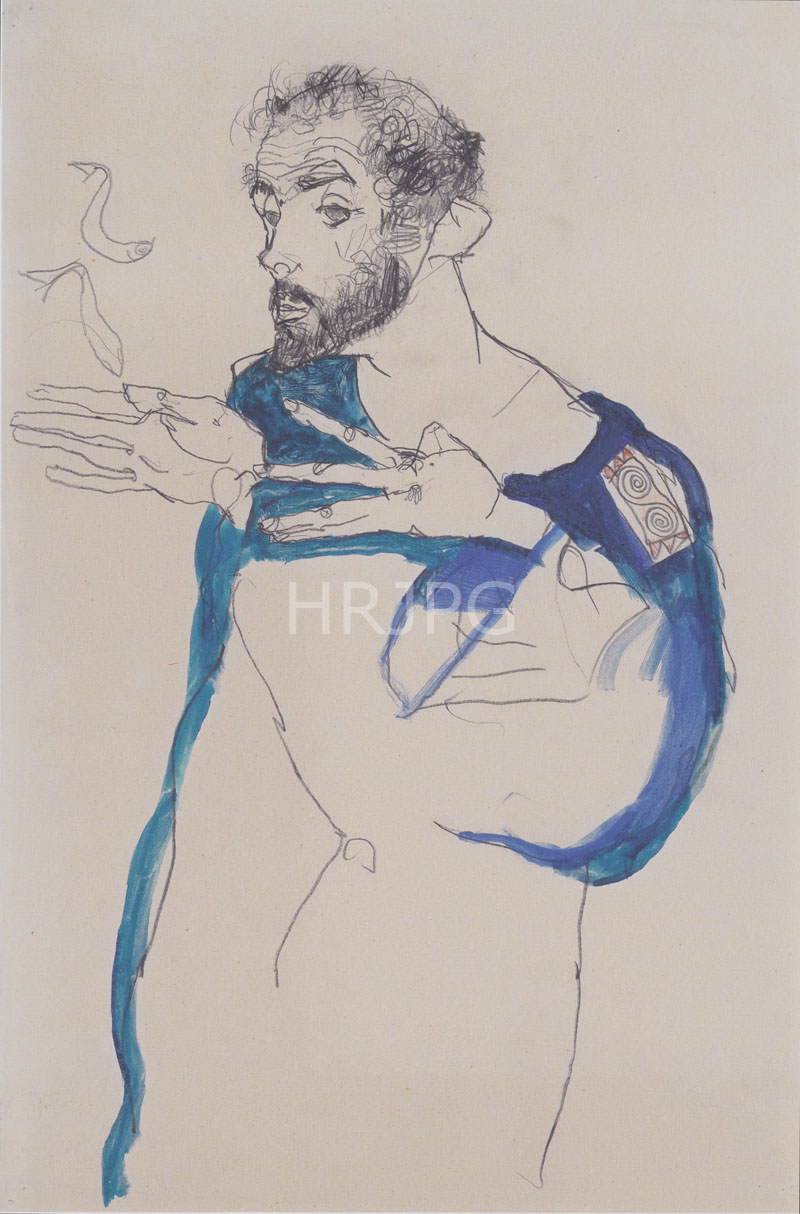
This iconic drawing was executed by Egon Schiele in 1913, capturing his mentor and father figure, Gustav Klimt, during a pivotal moment for both artists. At this time, Schiele had already established his own distinct Expressionist voice, yet his reverence for Klimt remained a defining element of his professional life. This portrait serves as a profound graphic meditation on the elder artist’s formidable presence, rendered not through realistic flattery but through the aggressive, nervous line work that became Schiele’s signature.
Technically, the work is characterized by Schiele’s masterful use of "jagged" contour lines that seem to vibrate with internal energy. The composition focuses almost entirely on Klimt’s head and shoulders, stripping away any environmental context to force a direct psychological confrontation. Schiele utilizes a limited palette, centered around a distinctive blue gouache wash that fills Klimt’s famous painter’s smock. This choice of color is symbolic; the deep, cold blue contrasts with the warmth of the parchment-toned skin, creating a sense of ethereal creative power. The use of negative space is strategic, as the unfinished edges of the garment suggest a figure that is too grand to be contained by the physical boundaries of the paper.
From a historical perspective, 1913 was a year of consolidation for the Viennese modernists. Schiele had recently emerged from a period of personal turmoil, and this portrait can be seen as an attempt to ground himself by connecting with the established "King of the Secession." The relationship between the two was reciprocal; while Klimt provided Schiele with patronage and early guidance, the raw intensity of Schiele’s Expressionism influenced Klimt’s later works, leading to more gestural and less ornate canvases.
Art criticism has long identified this portrait as one of the most successful "spiritual" likenesses in modern art. Rather than focusing on Klimt’s social status or his public persona as a dandy, Schiele presents him as a monklike visionary. The critic Jane Kallir notes that Schiele’s portraits of this period are "less about the appearance of the man and more about the climate of his soul." The work is frequently cited as a landmark in the evolution of Viennese Expressionism, demonstrating how Schiele transformed the decorative linear traditions of the Jugendstil into a medium for existential exploration. It remains a moving tribute from a student to a master, encapsulating the intense creative aura of turn-of-the-century Vienna.