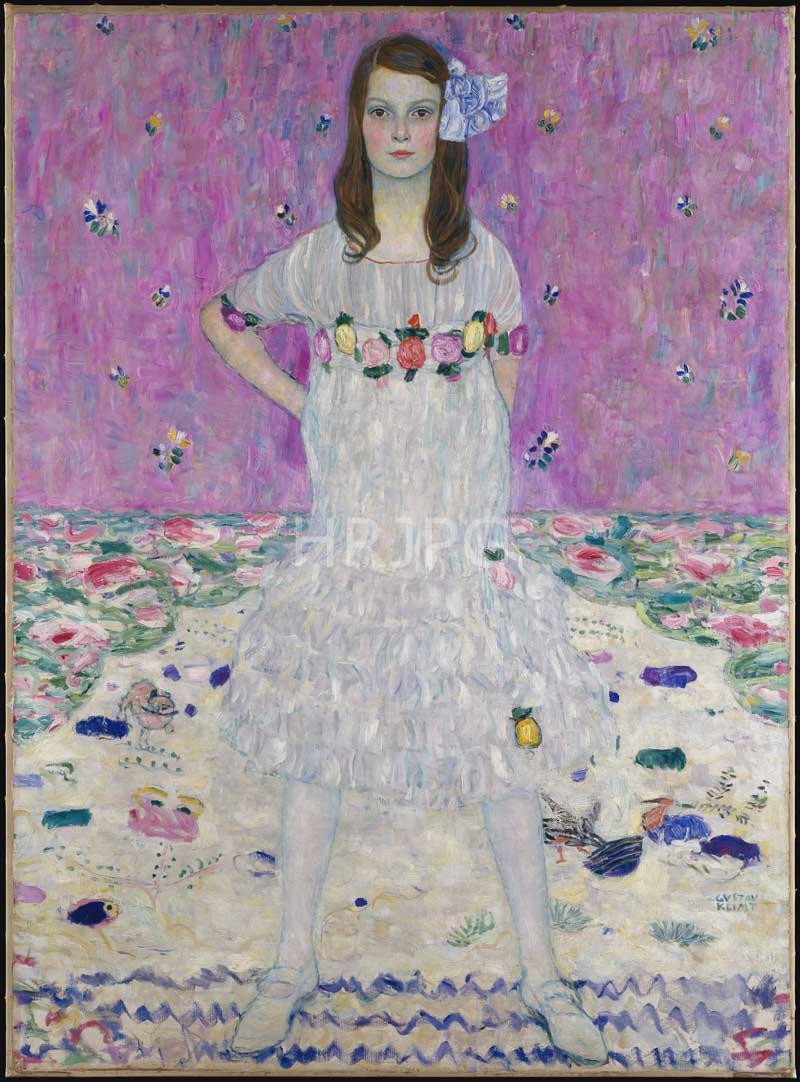
The portrait of Mada Primavesi was created by the Austrian artist Gustav Klimt around 1912 to 1913. This work represents a significant departure from the metallic, gold-leaf heavy aesthetic of his earlier "Golden Phase," signaling his transition into what art historians often call his "International Style." In this period, Klimt embraced a more vibrant, expressive color palette influenced by the Fauves and the burgeoning Expressionist movement in Europe. The painting depicts the young daughter of Otto and Eugenia Primavesi, prominent patrons of the Wiener Werkstätte, standing with a sense of defiant confidence that was unusual for child portraiture of the era.
Technically, the composition is a masterclass in the balance between figurative realism and decorative abstraction. Mada is positioned centrally, her white dress acting as a bright anchor against a riotous background of floral and geometric patterns. Klimt uses a vertical format to emphasize the girl's stature, while her wide stance and hands tucked behind her back convey a modern, youthful spirit. The color scheme is dominated by lush lilacs, oranges, and greens, applied with rhythmic brushstrokes that create a shimmering, tapestry-like surface. The floor is rendered with a dense pattern of spring flowers, which seamlessly merges into the wallpaper-like motifs of the background, illustrating the Secessionist ideal of the Gesamtkunstwerk where the subject and environment are part of a unified aesthetic whole.
Historically, this commission followed the portrait of Mada's mother, Eugenia Primavesi, and serves as a testament to the close relationship between Klimt and the wealthy industrialist families who sustained the Viennese avant-garde. The Primavesi family's estate in Moravia was a hub for artistic activity, and Klimt spent considerable time there, which likely contributed to the relaxed yet authoritative aura he captured in Mada’s expression.
Contemporary art criticism often highlights the psychological depth of this work. Unlike the passive, ethereal women of his earlier canvases, Mada appears as an active, conscious individual. Critics like Frank Whitford have noted that Klimt’s late portraits move away from the "fetishization" of the female form toward a more sincere investigation of personality. The painting was widely acclaimed for its "explosive" use of color, which signaled Klimt's ability to reinvent himself even in the final years of his life. Today, it is celebrated as one of the finest examples of early 20th-century portraiture, bridging the gap between Art Nouveau decorative tradition and the raw emotionality of modernism.