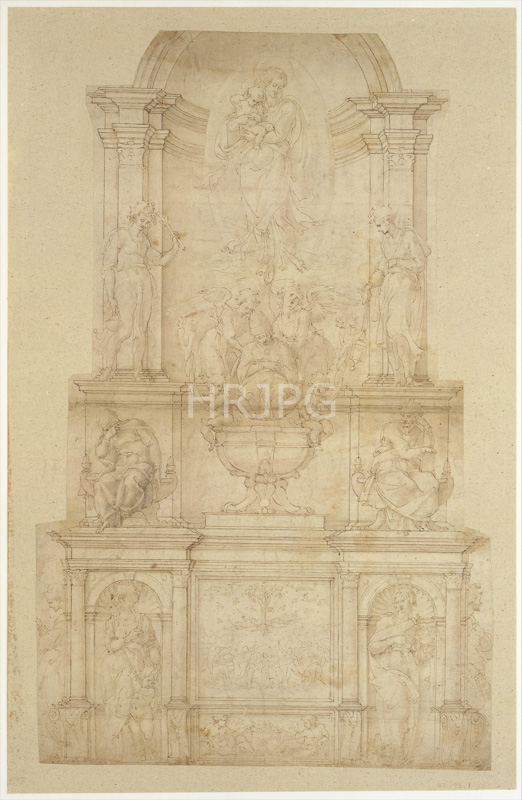
This architectural drawing represents one of the most ambitious and ultimately tragic projects of Michelangelo’s career: the tomb of Pope Julius II. Initially conceived as a massive, free-standing four-story monument to be placed in St. Peter’s Basilica, the project was scaled back numerous times over forty years, becoming what Michelangelo called the "tragedy of the tomb." This specific early design showcases the artists vision for a monumental wall tomb integrated with grand architectural structures. It features a multi-tiered facade with niches intended for over forty life-sized statues, including the famous "Moses" and the "Slaves." The drawing demonstrates Michelangelo’s unparalleled ability to synthesize sculpture and architecture into a unified, heroic expression of papal authority and divine grace.
The technical execution of the sketch highlights the clarity of Michelangelo’s spatial thinking. Using precise ink lines and subtle washes, he defines the rhythmic arrangement of columns, cornices, and decorative elements. The drawing serves as a blueprint for a structure that would have revolutionized funerary art, moving away from traditional gothic or early Renaissance types toward a more classical, triumphal vocabulary. Michelangelo focuses on the interplay of light and shadow within the architectural recesses, suggesting how the carved marble figures would interact with the surrounding space. The grandeur of the design reflects the immense ego of Julius II and the creative fire of a young Michelangelo, who believed he could transform a literal mountain of marble into a monument of eternal significance.
Historically, the project’s failure due to funding shifts toward the rebuilding of St. Peter’s and the artists forced labor on the Sistine Chapel ceiling led to a profound psychological burden for Michelangelo. However, the designs remained a primary influence on 16th-century tomb architecture across Italy. By studying this drawing, scholars gain insight into the "motions of the mind" of a master who sought to transcend the limits of the material world. It remains a vital document for understanding the foundations of High Renaissance monumentalism and the complex relationship between artistic ambition and the realities of political power, standing as a hauntingly beautiful blueprint for a masterpiece that was never fully realized in its original, colossal form.