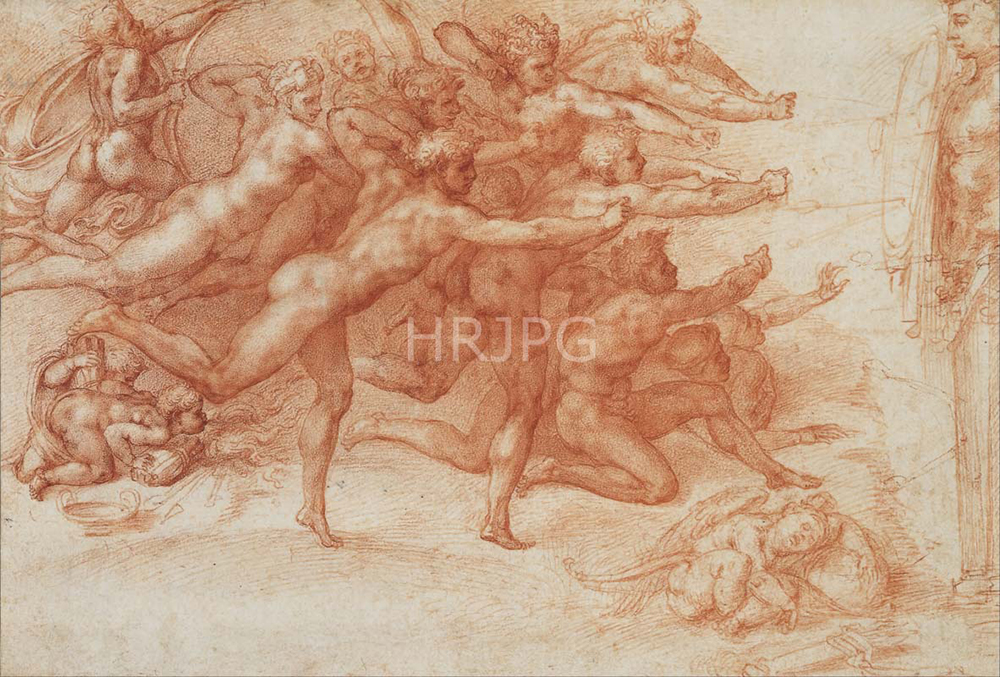
"Archers Shooting at a Herm" is one of Michelangelo’s most famous and enigmatic "presentation drawings," created as a gift for his friend Tommaso dei Cavalieri. This red chalk drawing is a complex allegory showing a group of nude archers aiming their bows at a herm (a pillar topped with a head), which is shielded by a target. The archers are shown without actual bows or arrows, emphasizing that the action is a spiritual or psychological one rather than a literal hunt. Michelangelo uses this scene to explore the human body in various extreme and dynamic poses, focusing on the tension, physical effort, and rhythmic harmony of the figures. The work is a tour de force of anatomical precision and a profound meditation on the nature of desire and the pursuit of an unattainable goal.
The technical execution of the drawing is a masterclass in red chalk technique. Michelangelo utilizes delicate hatching and subtle rubbing to create a sense of three-dimensional volume and lifelike skin texture that rivals the solidity of stone. The composition is characterized by a swirling, energetic motion that leads the viewer’s eye through the overlapping forms of the muscular archers. Every muscle and tendon is rendered with microscopic detail, reflecting the artist’s belief that the human form is the highest expression of the divine spirit. The use of "chiaroscuro" creates a powerful sense of atmospheric depth, making the figures appear as solid, sculptural presences within a dreamlike, ethereal space. This focus on the human nude in action was a hallmark of Michelangelo’s pedagogical approach to art.
Historically, the drawing has been interpreted through the lens of Neo-Platonic philosophy, where the "arrows" represent the soul’s longing for the ideal, and the "herm" represents the material world that remains unaffected by earthly desires. It showcases Michelangelo’s ability to imbue classical allegory with a modern sense of existential weight and emotional depth. Technically, the "Archers" set a new standard for finished drawings in the Renaissance, proving that chalk on paper could achieve the monumental impact of a fresco. Now held in the Royal Collection at Windsor Castle, it remains an iconic image of the High Renaissance, demonstrating why Michelangelo was considered the supreme master of the human condition and the "Divine" creator of images that continue to challenge and inspire the human intellect.