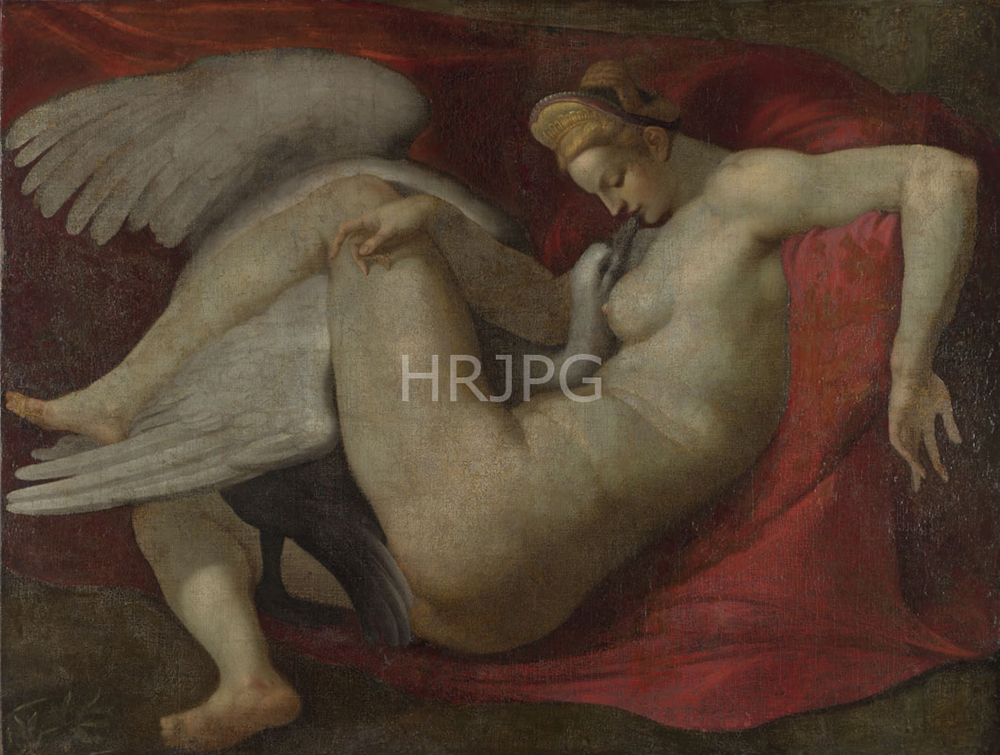
This painting is a contemporary copy of Michelangelo’s famous lost original depicting the mythological tale of Leda and the Swan. The original was created for Alfonso d'Este, the Duke of Ferrara, but was eventually sent to France and destroyed in the 17th century for its erotic content. This copy captures the complex, reclining pose of Leda and the erotic tension of the scene where Jupiter, in the form of a swan, seduces her. Michelangelo’s interpretation was groundbreaking for its focus on the physical weight and sculptural volume of the female nude, moving away from the more decorative approaches of his contemporaries. The work reflects the High Renaissance fascination with classical antiquity and the representation of the human body in states of mythological transformation.
The technical execution of the copy highlights the rhythmic harmony and the "figura serpentinata" that Michelangelo brought to the composition. Ledas body is shown in a state of extreme foreshortening and contortion, a tour de force of anatomical modeling that showcases the masters unique figure style. The use of vibrant, saturated colors and strong "chiaroscuro" creates a powerful sense of three-dimensional volume, making the figure appear as a solid, marble-like presence on the canvas. The interaction between the woman and the swan is characterized by a mix of tender intimacy and monumental dignity, a hallmark of Michelangelo’s ability to elevate sensual subjects into the realm of heroic art. The copy preserves the artists innovative approach to the female form, which influenced generations of European artists.
Historically, "Leda and the Swan" was one of Michelangelo’s most sought-after secular compositions, disseminated through numerous prints and painted replicas. It represents a rare moment where the artist engaged with purely mythological and erotic themes, albeit through a highly intellectual and sculptural lens. This painting provides an invaluable record of a lost masterpiece, showing how Michelangelo’s ideas continued to shape the development of Mannerist and Baroque art. Technically, the works focus on complex anatomical poses and psychological intensity set a standard for the representation of the reclining nude. It remains a vital subject of study for its unique synthesis of classical beauty and High Renaissance power, standing as a testament to Michelangelo’s enduring status as the supreme master of form in the Western tradition.