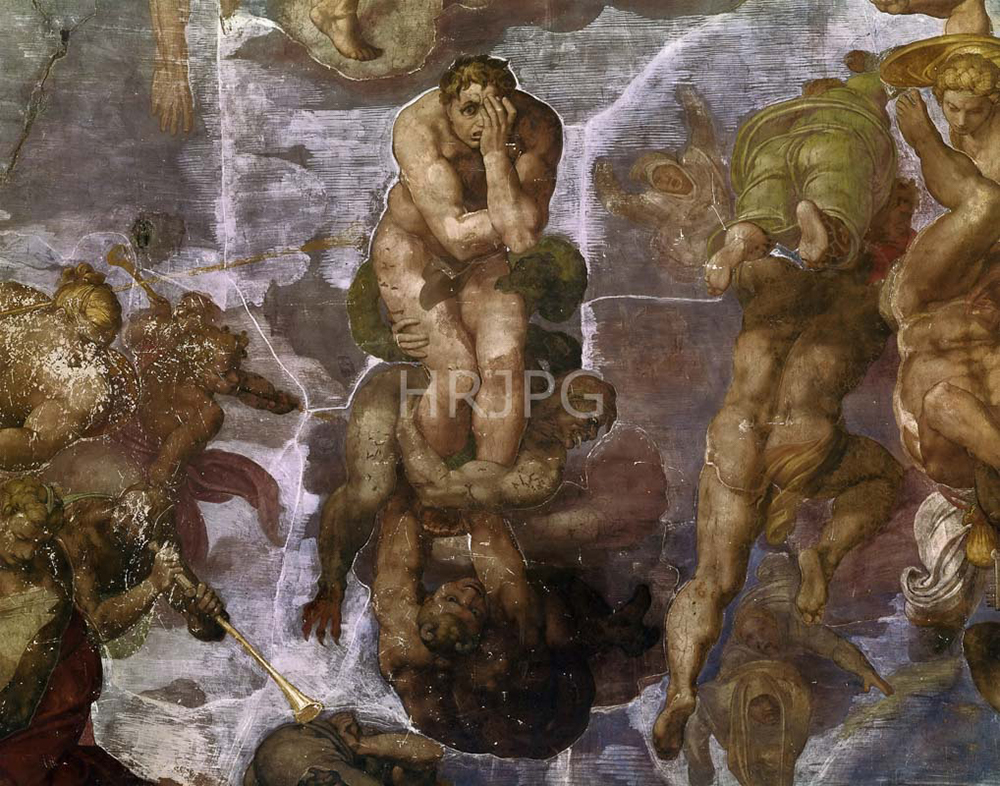
This haunting detail from "The Last Judgment," often referred to as "The Huddled Figure" or the "Damned Soul," is one of the most powerful icons of existential dread in Western art. Positioned on the lower right side of the altar wall, the figure is shown covering one eye in a gesture of silent, overwhelming horror as he realizes his eternal fate. Michelangelo departs from the heroic idealism of his earlier works to explore the raw psychological reality of absolute despair. The figure is not merely a victim of external demons but seems to be crushed by the weight of his own conscience. The contorted anatomy, with muscles tensed in a futile attempt to withdraw into himself, serves as a visceral visual metaphor for the internal psychological torment of the damned.
The technical execution of this figure highlights Michelangelo’s late mastery of "chiaroscuro." Deep, bruising shadows define the physical volume of the torso and limbs, creating a powerful sense of three-dimensional space within the crowded fresco. The skin tones are somber and cold, contrasting with the vibrant energy of the ascending souls. Michelangelo focuses on the tension in the neck and the single visible eye, which stares out with a terrifying clarity. This focus on the "motions of the mind" through anatomical contortion was a revolutionary step that would deeply influence the development of Mannerist and Baroque art. The figure appears almost sculptural, as if carved from the very atmosphere of divine judgment, embodying the inescapable reality of divine justice as conceived in the mid-16th century.
Historically, this "Damned Soul" has been interpreted as a reflection of Michelangelo’s own spiritual anxieties and his deep engagement with Dante’s "Divine Comedy." It represents a shift toward a more personal and emotionally raw vision of sacred history, reflecting the turbulence of the Counter-Reformation period. Scholars have noted that the figure’s isolation amidst the swirling vortex of souls makes his tragedy even more poignant, standing as a universal symbol of human vulnerability in the face of the infinite. It remains one of the most studied and admired fragments of the Sistine Chapel, demonstrating why Michelangelo was considered the supreme master of the human condition, capable of capturing the deepest anxieties of the soul through a singular, crystalline image of peak expressive power.