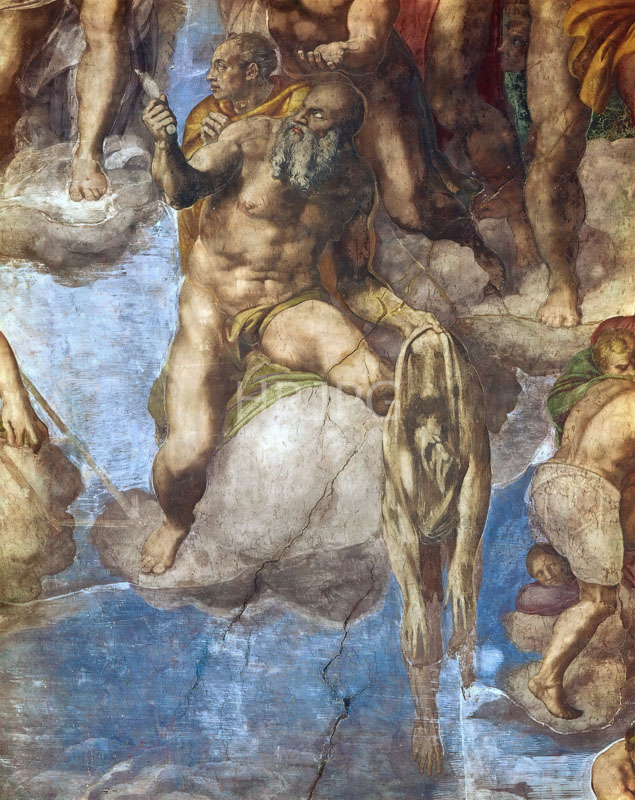
The figure of Saint Bartholomew in "The Last Judgment" is one of the most famous and unsettling details in the history of art. Positioned just below the right hand of Christ the Judge, the saint is shown holding his own flayed skin, the instrument of his martyrdom. This skin contains a haunting and tragic self-portrait of Michelangelo himself, a profound gesture of humility and a reflection of the artist’s late-life spiritual struggles. Bartholomew is rendered with a monumental, muscular anatomy, his stable pose contrasting with the sagging, distorted features of the flayed skin he carries. This juxtaposition creates a powerful visual metaphor for the physical reality of sacrifice and the ultimate victory of the soul over the mortal flesh.
The technical execution of this detail is a masterclass in the representation of varied textures and volumes. Michelangelo uses a sophisticated "chiaroscuro" to define the heroic muscularity of the living saint, while the skin is modeled with a pale, translucent luminosity that suggests its lifeless state. The focused expression of Bartholomew, looking toward Christ, conveys a sense of stern resolve and divine recognition. The use of rhythmic, overlapping forms links the saint to the surrounding martyrs, creating a sense of communal spiritual victory. This focus on the individual tragedy within the grand cosmic event is a hallmark of Michelangelo’s late humanism, where the human body remains the primary vehicle for communicating the deepest mysteries of the faith and the physical cost of devotion.
Historically, the inclusion of the artists self-portrait in the skin of a martyr has been interpreted as Michelangelo’s personal plea for divine mercy and a reflection of his belief in the "unmaking" of the self through the love of God. It reflects the intellectual and religious climate of the "Spirituali" circle in Rome, where personal spiritual renewal was paramount. Technically, the detail showcases the artists ability to combine anatomical rigor with a profound psychological interiority. It remains one of the most intellectually challenging and aesthetically daring fragments of the Sistine Chapel, standing as a testament to Michelangelo’s status as a visionary who could bridge the gap between sacred history and personal existential dread, securing his place as the supreme master of the human condition across the cities of Europe.