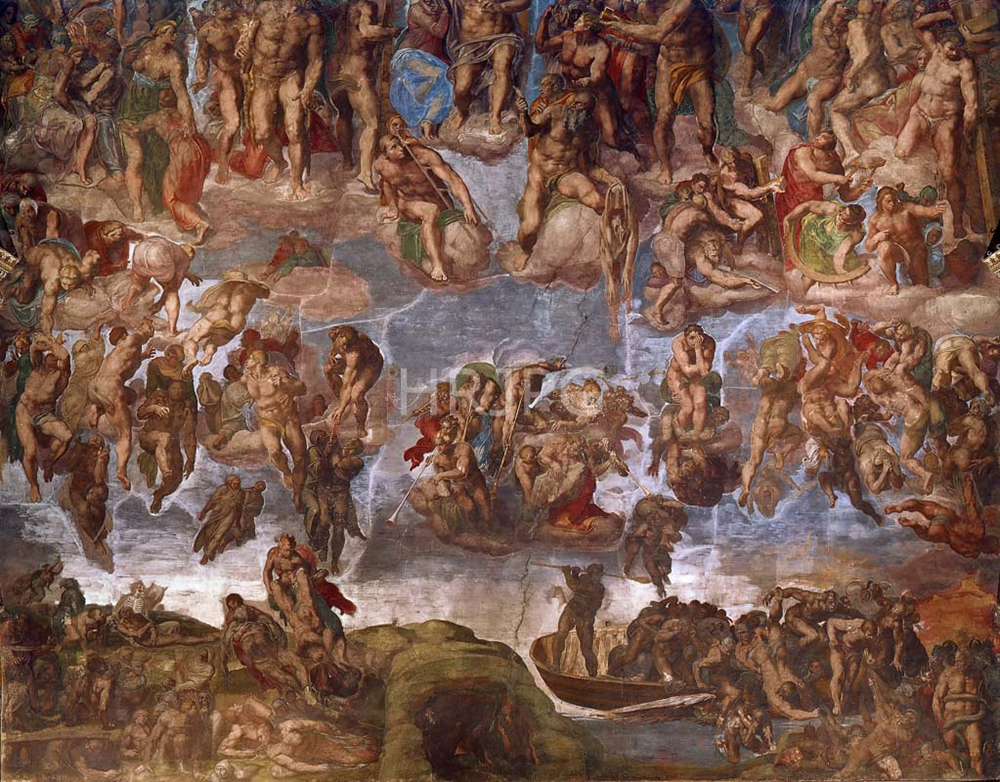
"The Last Judgment" is a monumental achievement that occupies the entire altar wall of the Sistine Chapel, commissioned by Pope Clement VII and completed under Paul III. This colossal fresco represents the final narrative climax of the chapel’s decorative program, depicting the Second Coming of Christ and the final judgment of all souls. Michelangelo departed from centuries of tradition by creating a swirling, unified vortex of over three hundred figures, centered on a youthful and Herculean Christ. The composition is characterized by its dynamic energy and its focus on the human body as the ultimate vessel for spiritual expression. This work reflects the religious turbulence and the shifting aesthetic toward the Mannerist style that defined the mid-16th century in Rome.
The technical execution of the fresco is a tour de force of scale, foreshortening, and anatomical complexity. Michelangelo utilizes a sophisticated sense of rhythmic harmony to organize the dense crowd of saved and damned souls, moving from the rising of the dead in the lower left to the infernal regions in the lower right. The use of deep, somber colors and strong "chiaroscuro" creates a powerful sense of atmospheric weight and psychological tension. The figures are modeled with a stone-like solidity that reflects the artist’s background as a sculptor, yet their contorted poses and expressive gestures convey a visceral sense of emotional raw energy. The overall effect is one of "terribilità"—a terrifying majesty that captures the gravity of eternal consequences and the absolute authority of the divine judge.
Historically, "The Last Judgment" was the subject of intense debate and controversy upon its unveiling, primarily due to the extensive nudity of the figures, which led to the "Cinquecento" campaign to cover them with drapery. Despite this, it was recognized immediately as a masterpiece of visionary art. It reflects the spiritual anxieties of the Counter-Reformation and Michelangelo’s own deep engagement with the themes of mortality and divine grace. Technically, the work set a new standard for monumental painting, influencing generations of artists across Europe who sought to master the complexities of the human form in extreme states of motion and emotion. It remains one of the most powerful and challenging religious images ever created, standing as an enduring testament to the unique genius of an artist who captured the entire spectrum of human and divine experience in a singular, crystalline masterpiece.